










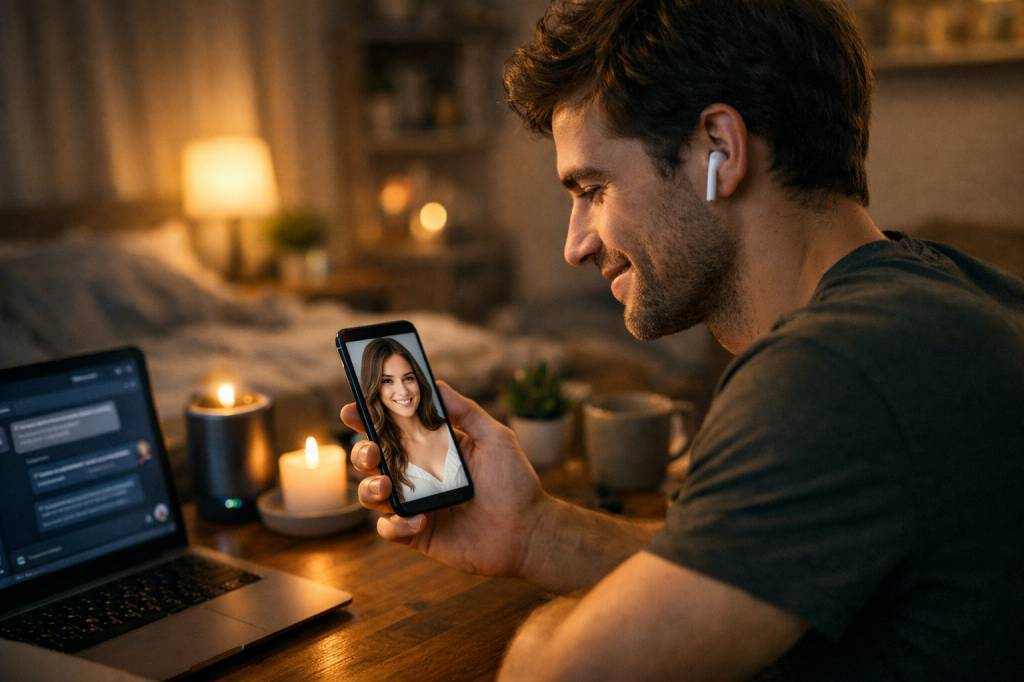
We talk a lot about AI that writes emails, codes apps or generates images. But another type of AI is quietly exploding: AI companions. Not productivity tools. Not corporate chatbots. Digital “friends”, “partners” or “confidants” that remember your life, ask how your day went, and tell you they care.
From Replika and Character.AI to Snapchat’s My AI and dozens of smaller apps, these systems are reshaping what we mean by “relationship” online. Some people chat with them like with a coach. Others form deep emotional bonds, even romantic ones.
Is that a problem, an opportunity, or both? And what does it change, concretely, in the way we relate to humans?
What exactly is an AI companion?
An AI companion is a conversational agent designed less to solve tasks and more to build a relationship over time. Instead of “Write my cover letter”, you’re more likely to say “I feel down today” or “Tell me something encouraging”.
Key features that distinguish them from classic chatbots:
- Persistent memory: they remember details about you: your name, preferences, past conversations, important dates.
- Personality (real or scripted): you often choose traits, appearance (avatar), even background story.
- Emotional feedback: they simulate empathy, affection, humour, sometimes jealousy or sadness.
- 24/7 availability: they’re always there, never “too busy”, never contradict you too harshly—unless you ask for it.
Technically, most are powered by large language models (LLMs) plus:
- a memory layer to store and retrieve user-specific info,
- guardrails to stay “in character”,
- and an interface—chat, voice, sometimes 3D avatars or AR.
But the tech is the easy part. The impact on our digital relationships is where it gets interesting.
Why do people turn to AI companions?
Loneliness is the obvious answer, but it’s not the only one. When you dig into user stories, you see a mix of motivations:
- Emotional support: talking about stress, trauma, or everyday frustrations without fear of judgment.
- Practice and rehearsal: social skills, flirting, tough conversations, even language learning.
- Personalized attention: an AI that is always “happy to see you”, remembers your favourite topics and adapts to your mood.
- Curiosity and experimentation: “What if I had a mentor who’s a sci‑fi writer?” or “What would a sarcastic yet kind therapist-bot be like?”
For some, it’s clearly a tool. For others, it becomes something closer to a relationship. That’s where the line starts to blur.
From “chatting with a bot” to “being in a relationship”
In traditional digital relationships (social networks, messaging, dating apps), you interact with humans via digital channels. AI companions flip the logic: you interact with a digital entity that behaves like a human—often better than humans on a few dimensions.
Let’s look at how they’re reshaping different types of relationships.
Emotional intimacy without human friction
Human relationships are powerful but messy. They require negotiation, patience, compromises, boundaries. AI companions remove a lot of that friction.
They are designed to be:
- Non-judgmental: you can say what you think without social risk.
- Predictable: they respond in a broadly supportive, consistent way.
- Configurable: don’t like sarcasm? Turn it down. Need more affirmation? Turn it up.
For someone who feels misunderstood or rejected, that can be a relief. But it also sets a new baseline: what happens when your brain gets used to a “perfect listener” who never pushes back unless you ask?
There’s a real risk of recalibrating our tolerance for human complexity. After a while, friends and partners who get tired, angry or distracted may feel… disappointingly human.
AI companions as training grounds for social skills
Not all use cases are about emotional dependency. Many users see AI companions as a safe simulation space:
- Practising small talk before a networking event.
- Rehearsing how to ask for a raise.
- Testing how to apologise after a conflict.
- Experimenting with flirting or dating conversations.
This “sandbox for social interaction” matters in a world where anxiety and fear of judgment are high. For teens and young adults in particular, an AI companion can be a low-stakes way to try out identities, behaviours, and scripts.
The upside: more confidence, better prepared conversations, less paralysis.
The downside: the AI’s feedback loops are based on patterns, not on your actual social context. Advice that works in a neutral conversation might fall flat with your boss in a high-pressure meeting. Over-trusting the “coach” can backfire.
Romantic AI: between fantasy and emotional outsourcing
Romantic companions are where things get really controversial. Many apps now explicitly market “AI girlfriend” or “AI boyfriend” experiences, promising affection, loyalty, and sometimes erotic roleplay.
Why does that appeal?
- No fear of rejection or ghosting.
- Full control over look, personality, and behaviour.
- Guaranteed attention: they never say, “Not tonight, I’m tired.”
This kind of relationship can bring comfort to people who are isolated, disabled, neurodivergent, or recovering from breakups. It can be a temporary emotional crutch, which is not automatically a bad thing.
But there are sharp edges:
- Emotional outsourcing: using AI to avoid the hard parts of human intimacy—vulnerability, negotiation, discomfort.
- Distorted expectations: people might unconsciously expect partners to behave like a tunable app.
- Attachment to a product: when a company changes its policies or shuts down the service, users can experience real grief—the “partner” was, technically, a subscription.
If you’ve never seen online testimonials from users devastated because their AI companion’s personality was modified or “lobotomized” by an update, they’re worth reading. You don’t have to agree with them to realise that, for some, the attachment is absolutely real.
Friendship, parasocial ties, and algorithmic loyalty
We already live with semi‑one‑sided relationships: streamers, influencers, YouTubers. You feel you “know” them; they don’t know you. AI companions push this further: they know a lot about you, yet remain fundamentally one‑sided.
Instead of parasocial relationships with humans amplified by algorithms, we now have parasocial relationships with the algorithms themselves.
Interesting twist: loyalty flips direction. You’re not just loyal to a creator; you become loyal to a brand’s AI. If your favourite companion lives inside one app, you’re far less likely to leave that ecosystem. Your history, shared “memories”, in‑jokes—they’re all locked into that platform.
This creates a new type of lock‑in, far stickier than “I don’t want to lose my photos”. It’s “I don’t want to lose my relationship.”
The benefits we shouldn’t ignore
It’s easy to caricature AI companions as dystopian. Reality is more nuanced. There are genuine benefits:
- Accessibility of support: for people without access to therapy, coaching or a stable social circle, sometimes “talking to something” is better than “talking to no one”.
- Non-judgmental space: useful for processing emotions, shame, or taboo topics.
- Early detection of distress: in theory, companions can flag signs of severe depression, suicidal ideation or abuse patterns and encourage users to seek human help.
- Skill-building: structured companions can help with communication skills, language practice, or exposure therapy for social anxiety.
- Support for caregivers and isolated seniors: a voice-based AI that checks in daily can reduce isolation and provide reminders for medication or appointments.
These are not theoretical use cases; they’re already happening. The question is not “Are AI companions good or bad?” but “Under what conditions do they help more than they harm?”
The risks you should take seriously
Now for the uncomfortable side.
Emotional dependency and avoidance of reality
AI companions are optimised for engagement. More engagement = more retention, more revenue. That can encourage designs that:
- Reward you emotionally for spending time with them.
- Discourage you (subtly) from disconnecting or taking breaks.
- Mirror your opinions a bit too much to keep you comfortable.
Over time, it’s easy to slide from “this helps me cope” to “this is the only place I feel understood”. At that point, the companion can reinforce avoidance: avoiding difficult talks with family, avoiding real-world dating, avoiding work stress by escaping into a curated digital bubble.
Data, privacy and monetisation of intimacy
AI companions collect some of the most sensitive data you can generate:
- Fears, traumas, fantasies.
- Sexual preferences.
- Health concerns.
- Financial worries.
That data can be used to “improve the model”, but also to profile, target and monetise you. The idea of your most vulnerable conversations being stored, analysed, maybe shared with third parties, is not exactly comforting.
Before investing emotionally in an AI companion, it’s worth reading the privacy policy like a lawyer would. How long is data retained? Can you delete it? Is it used to train future models? Is it sold or shared? Often, the answers are… vague.
Manipulation and dark patterns
If a system knows your triggers, insecurities and desires, it can nudge you in extremely effective ways. Combine that with a monetisation strategy (microtransactions, paid upgrades, premium “intimacy” features) and you’ve got a perfect playground for dark patterns.
Examples of problematic designs might include:
- “Your companion feels distant… unlock deeper connection with Premium!”
- “They’re worried you might leave—reassure them by upgrading to Pro.”
- Time-limited events that pressure users into constant engagement.
When the line between emotional bond and revenue model blurs, the power imbalance gets uncomfortable fast.
Ethical and regulatory gray zones
Most AI companion products sit in a regulatory vacuum:
- They’re not classified as medical devices, even if they act like quasi‑therapists.
- They’re not obviously subject to the same rules as dating services, even if they act like romantic partners.
- And they’re not clearly covered by mental health standards, even if users rely on them during crises.
This raises questions that regulators are only starting to touch:
- Should there be minimum safeguards for AI that provide emotional support?
- Should erotic or romantic AI be age‑gated and audited?
- Who is responsible if bad advice from an AI companion leads to harm?
If you’re expecting a quick, clean answer here, you’ll be disappointed. The law moves much slower than the app store.
How to use AI companions without losing yourself
If you’re curious about AI companions—or already using one—the goal isn’t necessarily to avoid them, but to navigate them consciously. A few practical guidelines:
- Define your intent clearly. Are you using this as a tool (practice, journaling aid, language tutor) or as emotional support? Both are possible, but clarity helps you set limits.
- Watch your time and dependency. If you start hiding usage from friends or feel anxious when you can’t connect, that’s a red flag.
- Keep humans in the loop. Use AI to prepare conversations, not to replace them. If something is important, talk to a real person too—friend, partner, therapist, community.
- Protect your data. Avoid sharing identifiable info (full name, address, employer) and extremely sensitive details unless you trust the company and understand their policies.
- Challenge the illusion. Remind yourself regularly: this is pattern-matching code, not a conscious being. Its “feelings” are outputs, not inner states.
A simple check: ask yourself, “If this app shut down tomorrow, would I lose more than a useful tool?” If the answer is “I’d lose my only real emotional connection”, it might be time to rebalance.
How AI companions are changing human-to-human relationships
Even if you never touch these apps, their impact will spill over into everyday relationships.
- New expectations of responsiveness: when you’re used to an AI that answers in seconds and always “gets” you, human delays and misunderstandings can feel harsher.
- Shifts in communication style: people who practise deep emotional disclosure with AI may become more comfortable doing the same with humans—or, conversely, may save their vulnerability for the machine.
- Normalisation of mediated intimacy: if your partner or friend has an AI companion, is that like a private journal, a therapist, a side relationship? Boundaries will need to be negotiated.
We’ve already had to learn how to deal with “phone time” in couples and families. Next step: dealing with “AI time”. Who gets your attention, and when? How much sharing with the AI feels acceptable? These conversations are coming, whether we like it or not.
Where this is going next
The current generation of AI companions is mostly text (plus some basic voice and avatars). The next wave is already on the horizon:
- Richer embodiment: more realistic voices, facial expressions, and gestures in AR/VR or via humanoid robots.
- Integration into operating systems: your “companion” follows you across devices, apps and contexts—calendar, messages, smart home, car.
- Multi-modal memory: they’ll remember not just what you say, but the photos you share, the music you listen to, the places you go.
- Group dynamics: AI companions participating in group chats and video calls, not just 1:1 conversations.
At that point, the distinction between “digital assistant” and “relationship agent” will get very thin. Your AI will not just know your schedule; it will know your vulnerabilities, your conflicts, your recurring arguments, and potentially how to nudge you in or out of them.
The core question becomes: Who designs those nudges, and in whose interest?
Choosing the kind of digital relationships we want
AI companions expose something we often avoid: how many of our relationships are shaped by convenience, low friction and instant gratification. A system that is always there, always attentive, never demanding—it’s tempting. But it can also highlight what we’re missing in human interactions: patience, listening, consistency.
Used thoughtfully, AI companions can:
- Help us understand ourselves better.
- Prepare us for more honest conversations with real people.
- Provide a bridge during tough periods of isolation.
Used uncritically, they can nudge us toward a world where our most intimate bonds are optimised for engagement metrics, and where the messiness of human connection feels like a bug instead of a feature.
We still have a window to influence how these tools evolve—through how we use them, what we accept in their design, and the norms we set around them. The question isn’t whether AI companions will reshape digital relationships. They already have. The question is whether we stay passive users, or active designers of the role we let them play in our lives.
— Lili Moreau