











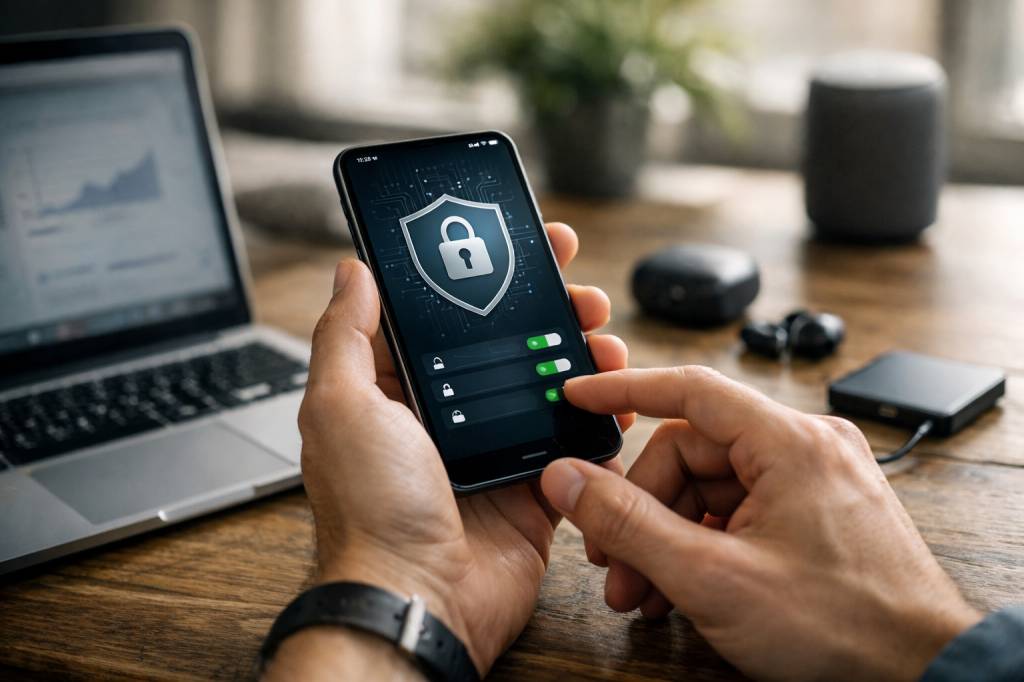
The silent revolt against surveillance-by-design
For years, the dominant narrative in tech has been simple: if you want powerful, convenient apps, you have to trade your data. Your contacts, your location, your habits, your voice, your photos — everything was “fuel” for better services.
That deal is breaking.
Across messaging, browsing, productivity, finance, even fitness, a new generation of tools is emerging with a radically different promise: you stay in control of your data by default. No dark patterns, no “accept all” traps, no 30-page terms of service to justify aggressive tracking. Just privacy-first by design.
This isn’t a niche trend for paranoids with tinfoil hats. It’s shaping the next big shift in our digital lifestyle, and it’s happening faster than most people realise.
Why privacy suddenly matters to “normal” users
For a long time, privacy sounded abstract. Something for lawyers, activists, or people with “something to hide”. Yet three converging forces have moved it into the mainstream.
1. Scandals made surveillance tangible
Cambridge Analytica using Facebook data to target voters. Massive breaches exposing millions of passwords, health records, even DNA data. Location data sold to third parties who can track visits to clinics, religious places, or protests.
These aren’t hypotheticals. They’re headlines. And they’ve put a simple question in everyone’s mind: “If they have all this on me… what else can they do?”
2. Your phone became a portable black box of your life
Smartphones now hold:
- Your social graph (messages, contacts, social media).
- Your movements (location history, check-ins, mobility data).
- Your habits (sleep, steps, workouts, payments, mood-tracking).
- Your thoughts and work (notes, docs, photos, audio memos).
That density of information makes misuse exponentially more dangerous. Losing “some data” doesn’t mean just a spam email anymore; it can mean comprehensive profiling.
3. Regulation is forcing transparency
GDPR in Europe, CCPA in California, and similar laws worldwide have forced apps to explain what they collect and why. Once users started actually seeing how much data an app wanted, many simply thought: “No, thanks.”
Apple surfed this wave brilliantly. App Tracking Transparency (the “Ask App Not to Track” pop-up) exposed how widely many apps followed users across services. The result? According to multiple industry estimates, more than 75% of iOS users now refuse cross-app tracking.
The message is clear: when people are given a real choice, they don’t want to be tracked.
What defines a privacy-first app (beyond marketing buzzwords)
Every second app now claims to be “secure” or “respectful of your privacy”. That doesn’t mean much. Privacy-first is not a slogan; it’s an architecture and a business model.
Here are the concrete signs you’re dealing with a genuine privacy-first application:
- Data minimisation: the app collects only what it truly needs to function. No “just in case” or “for future product improvements” excuses.
- End-to-end encryption where it makes sense: messages, backups, sometimes even notes and files are encrypted so that even the provider can’t read them.
- Local-first processing: anything that can run on your device does run on your device — especially analytics, AI features, or personalisation.
- Clear, granular permissions: you understand exactly why the app asks for location, camera, microphone, or contacts — and you can say no without breaking everything.
- No dark patterns: no manipulative UX to push you into “accept all”, no pre-checked “share with partners” boxes.
- Transparent, sustainable business model: revenue comes from subscriptions, one-time purchases, or transparent B2B deals — not from reselling behavioural data.
When you stack these elements, privacy stops being a legal checkbox and becomes a design principle that shapes every feature.
From messaging to money: where privacy-first is already winning
Some categories are already deeply transformed by privacy-first players. Others are just starting to move. Let’s look at a few that impact everyday digital life.
Messaging: the gateway drug to privacy
WhatsApp normalised end-to-end encryption for billions of people. Signal pushed it further with open-source code, minimal metadata, and no commercial tracking. Apps like Threema, Session, or Matrix-based tools go even more radical.
The result: using encrypted messaging is now ordinary behaviour, not a suspicious signal. That single shift has prepared users psychologically to accept the idea that privacy by default is reasonable, not extreme.
Browsing: the ad-blocker generation grows up
Ad-blockers were many people’s first privacy tool — even if they installed them for comfort rather than ethics. Now, browsers themselves integrate protection:
- Safari and Firefox block third-party cookies by default.
- Brave and DuckDuckGo block trackers and fingerprinting aggressively.
- Chrome, under pressure, is slowly deprecating third-party cookies and reinventing its ad tech.
Again, once users experience “the web, but calmer and cleaner”, they rarely go back.
Productivity: from “in the cloud” to “on your terms”
Notes apps, to-do lists, calendars, password managers: these are intimate tools. They know your projects, your mental load, sometimes your secrets.
Privacy-first alternatives are emerging fast:
- Local-first or end-to-end encrypted note apps and knowledge bases.
- Password managers that can work offline with zero-knowledge architecture.
- Project management tools that avoid heavy tracking of user behaviour.
For freelancers, remote teams, and creators, these tools align better with the idea that “my data is part of my intellectual capital”.
Finance and health: the non-negotiable domains
Money and health data are extremely sensitive by nature. Fintech and healthtech startups that ignore privacy now start with a credibility gap.
On the other hand, services that can credibly claim:
- No selling of transaction data to third parties.
- Strong anonymisation for analytics.
- Encryption at rest and in transit, with clear security audits.
…gain a serious trust advantage, especially among younger, digitally educated users.
How AI accelerates the need for privacy-first design
Layer generative AI and large language models on top of this ecosystem, and the equation changes drastically.
To “personalise” and “learn”, many AI features try to ingest everything: documents, emails, chats, photos, browsing history. In the wrong hands, that’s a surveillance dream.
Privacy-first AI apps are taking the opposite path:
- On-device models: small but efficient models running locally for text completion, classification, summarisation, or recommendations — keeping raw data on your device.
- Encrypted context: when cloud models are used, the context sent is minimised, sometimes pseudonymised or encrypted, and never reused for training without explicit consent.
- Scoped assistants: AI agents restricted to a defined space (your notes, your tasks) rather than crawling your entire digital life indiscriminately.
As AI becomes embedded into every tool, from email to photo galleries, privacy-first will be the only sustainable way to scale trust. Without it, every AI feature is a potential reputational time bomb.
Why this is a lifestyle shift, not just a tech trend
Let’s be clear: most people will never read a white paper on encryption. They won’t compare threat models or track the latest privacy frameworks.
Yet their daily habits are changing in ways that add up:
- They refuse tracking when asked clearly.
- They move conversations to apps they “feel safer” on.
- They use private browsing modes or alternative search engines.
- They pay small subscriptions to avoid ads and trackers.
This signals a deeper cultural shift in how we relate to digital services:
From: “It’s free, so obviously they’ll use my data. That’s life.”
To: “If it’s constantly harvesting my data, it should justify why — and what I get in return.”
Once users start thinking in those terms, app makers are forced to treat privacy like UX: a core part of the experience, not a compliance checkbox.
But aren’t privacy-first apps less powerful?
This is the usual argument: if you lock down data, you lose innovation. No more smart recommendations, no more helpful AI, no more “it just works” magic.
In practice, three things have changed:
1. Devices are powerful enough to do real work locally
Today’s smartphones and laptops can handle encryption, local machine learning, and complex sync logic without breaking a sweat. The cloud is no longer the only realistic option for “smart” features.
2. New architectures make privacy compatible with sync
Local-first software, CRDT-based sync, end-to-end encrypted storage — these approaches allow apps to:
- Keep data encrypted in the cloud.
- Sync changes across devices.
- Still offer collaboration and offline-first behaviour.
It’s harder to build, yes. But we’re past the experimental phase; robust toolkits and standards are emerging.
3. Personalisation doesn’t need your entire life story
Do you really need cross-app tracking to show someone a relevant article, recipe, or video? Not necessarily.
On-device learning, ephemeral profiling (that’s not stored long-term), and privacy-preserving analytics (like differential privacy) allow useful personalisation with vastly reduced risk.
What this means if you’re a user
If you’re not building apps but simply living in this digital ecosystem, how do you ride this shift instead of enduring it?
Audit your “data footprint” apps
List the apps that see the most intimate parts of your life:
- Messaging and social apps.
- Cloud storage, notes, calendars, email.
- Health, fitness, and mental health trackers.
- Finance, budgeting, banking apps.
For each category, ask:
- Do I know their business model?
- Could I switch to a more privacy-respecting alternative without losing critical features?
- Have I checked the permissions they’re using recently?
Use system-level protections
Modern OSes give you surprisingly good control — if you use it:
- Revoke background location access for apps that don’t really need it.
- Block cross-app tracking when prompted.
- Limit microphone and camera permissions to “while using the app”.
- Use separate profiles or browsers for work, personal life, and experiments.
Accept that sometimes, privacy is worth paying for
Free isn’t bad by definition. But if the product is complex, well-maintained, and offered by a small team with no visible revenue source, you should ask how it survives.
Subscriptions for private email, VPNs, encrypted storage, or password managers may feel like small annoyances. They’re also votes for a different digital economy.
What this means if you’re a builder
If you design or develop digital products, ignoring this shift is risky. Privacy-first is quickly moving from “nice differentiator” to “base expectation”.
Design privacy as a feature, not a disclaimer
Don’t bury your privacy logic under legalese. Surface it in the product:
- Explain, in plain language, why you ask for each permission.
- Offer obvious “private modes” when relevant.
- Give users data controls that actually do something (export, delete, off-switches).
Align your business model early
If your revenue depends on behavioural advertising or reselling data, be honest: you will hit a trust ceiling.
Ask yourself:
- Could we move to a freemium or subscription model?
- Can we offer analytics to clients in an aggregated, anonymised form that doesn’t expose individuals?
- What’s the minimum data we truly need to deliver value?
Use privacy as a product constraint
Instead of thinking “we’ll collect everything and see what’s useful later”, try designing features with this rule:
“If we couldn’t read user data in clear text, how would we still deliver this feature?”
This forces smarter architectures: local-first, encrypted metadata, selective sync. It also makes your product more resilient in a world with tighter regulation.
Regulation, trust, and the next five years
We’re heading toward a landscape where:
- Regulators will tighten rules on profiling, especially for minors.
- Browsers and OSes will keep cutting off easy tracking mechanisms.
- Users will default to “no” when asked for unclear data permissions.
In that context, building on “surveillance-by-default” is not just ethically questionable; it’s strategically unsound.
Privacy-first apps, on the other hand, benefit from:
- Lower regulatory risk.
- Stronger long-term brand trust.
- A better relationship with users, based on explicit consent rather than hidden extraction.
As digital lifestyles become denser — more sensors, more AI, more automation — the asymmetry of power between platforms and individuals will keep growing. Privacy-first design is not about going “off-grid”; it’s about rebalance.
Making privacy-first your default setting
You don’t have to become a security expert or a crypto-nerd to adapt. You can start simple:
- Pick one category this week (messaging, notes, or browser) and try a privacy-first alternative seriously for 7 days.
- Clean up app permissions on your phone — you’ll be surprised how many apps had access they no longer need.
- For every new app you install, ask: “What’s their business model, and what’s my data worth in that equation?”
Our digital lifestyle has been shaped for a decade by the idea that more data is always better. The next decade will be defined by a different question: “Better for whom?”
Privacy-first apps don’t promise to stop technology from changing our lives. They promise something more subtle, and more radical: letting us enjoy that change without giving up control of who we are, what we do, and who gets to turn it into a spreadsheet.
That’s not a minor UX tweak. It’s a new default — and it’s arriving faster than most people think.