










Passwords were never designed for the life we live online today. They were invented in the 1960s for a handful of researchers sharing a mainframe, not for billions of people juggling dozens of accounts, smartphones, cloud services and AI tools. Yet here we are in 2025, still typing “Password123!” and pretending that adding an exclamation mark somehow makes it unbreakable.
Let’s be honest: the traditional password system is broken. It’s time to say it clearly. And that’s exactly why “passwordless login” is not just a buzzword – it’s a structural shift in how we think about identity and security on the internet.
Why passwords have become a security liability
Before talking about what’s next, it’s important to understand why the current model is failing so badly.
On paper, passwords sound simple: something you know, that only you know. In reality, almost nobody uses them the way security experts wish they would.
Typical user behavior looks more like this:
- Reusing the same or similar password across multiple sites
- Using predictable patterns: name + date of birth + “!” or “123”
- Storing passwords in notes apps, emails or screenshots
- Ignoring or postponing password change prompts
The result speaks for itself. According to Verizon’s Data Breach Investigations Report, weak or stolen credentials remain one of the main causes of security incidents year after year. Once a single website is hacked, password reuse means attackers can often access mailboxes, cloud storage, social networks, sometimes even banking apps via simple credential stuffing (trying the same combo on multiple sites).
And what have we done to fix this? We’ve added complexity on top of complexity:
- “Your password must contain 12 characters, a capital letter, a symbol, a hieroglyph and a blood sacrifice.”
- Mandatory rotations every 60 or 90 days.
- Security questions whose answers are easily found on social networks.
Users are exhausted. Security teams too. The system is not just fragile, it’s hostile to the people who are supposed to use it.
What “passwordless login” really means
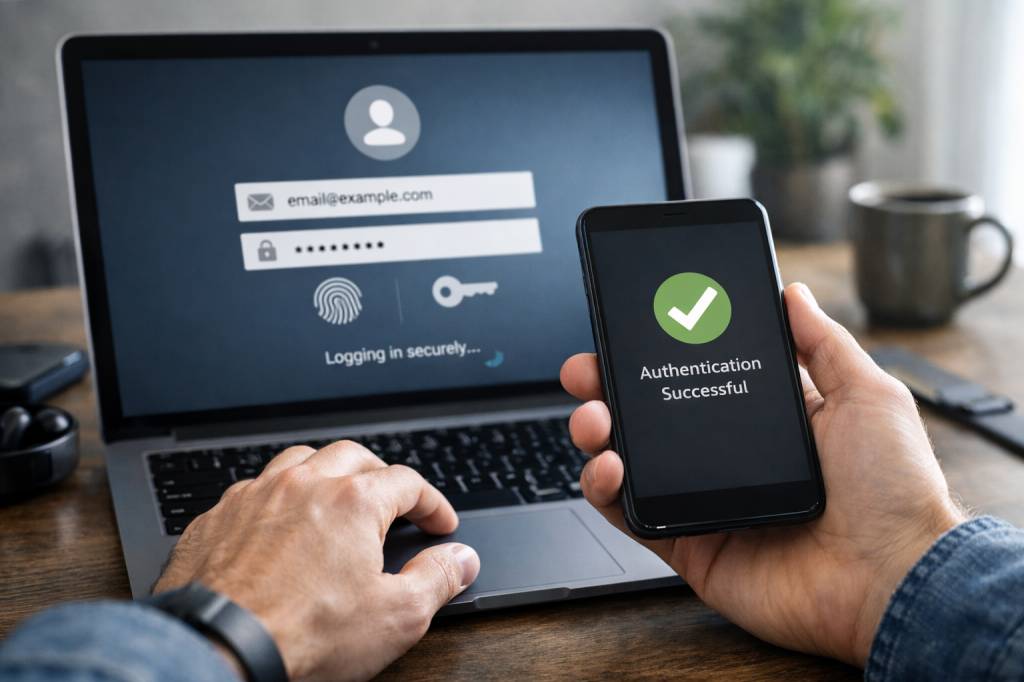
Let’s demystify the term. Passwordless login does not mean “no security” or “login by magic”. It means replacing the “something you know” (a secret string of characters) with mechanisms based on “something you have” and/or “something you are”.
Behind the marketing, passwordless usually relies on one or more of these methods:
- Device-based authentication (smartphone, security key, laptop): your device stores a cryptographic key that proves your identity without exposing any secret over the network.
- Biometrics (fingerprint, Face ID, Windows Hello): your body becomes the unlock method for that cryptographic key.
- One-time links or codes (magic links, email/SMS codes): instead of a static secret, you receive a temporary token tied to your identity.
The key point: your “secret” never travels unchanged over the internet and never sits the same way in a server database. Even if a database is compromised, attackers don’t get reusable passwords they can paste elsewhere.
In practice, you’re starting to see passwordless everywhere without always naming it:
- Logging into your Microsoft or Google account using a fingerprint on your smartphone
- Using Face ID to access your banking app instead of entering a PIN
- Clicking a “magic link” sent to your inbox to connect to a service
What’s changing now is that this approach is becoming a standard, not just a convenience feature for a few apps.
Passkeys: the backbone of the passwordless future
If there’s one term to remember in 2025 about passwordless login, it’s this one: passkeys.
Passkeys are a standardized way to log in using public-key cryptography, without passwords, across different devices and platforms. They’re built on the FIDO2 and WebAuthn standards, backed by the FIDO Alliance – whose members include Apple, Google, Microsoft, Amazon, Meta, and many major banks.
How it works in simple terms:
- When you create an account with a passkey, your device generates a cryptographic key pair:
- a public key, sent to the website or app
- a private key, stored safely on your device, never shared
- When you log in, the website sends a challenge (a kind of mathematical puzzle) to your device.
- Your device signs this challenge with the private key, after you unlock it with your fingerprint, face, PIN, etc.
- The website verifies the signature with the public key. If it matches, you’re in.
No password is ever transmitted. There’s nothing for a keylogger to capture, nothing for a phishing email to ask you to “re-enter”, nothing usable to steal from a database.
Today, passkeys are already supported by Chrome, Safari, Edge, Android, iOS, macOS and Windows. In other words: the infrastructure is ready. What’s missing is the adoption curve on the service side and the cultural switch on the user side.
Why passwordless is stronger than “strong” passwords
You might think: “I already use a password manager and long, unique passwords. Isn’t that enough?” For a power user, it’s already a big step up. But passwordless changes the game at a structural level. Here’s why.
- Nothing to steal in bulk
Traditional passwords live on servers (hashed, ideally). In a data breach, attackers can exfiltrate millions of hashed passwords and try to crack them offline. With passkeys and similar mechanisms, servers only store public keys. By definition, they’re not secrets. - Resists phishing by design
Phishing relies on tricking you into typing your password on a fake site. Passkey-based login is bound to the legitimate domain. If someone clones “g00gle.com” to steal your Google credentials, your browser won’t present your real passkey to that domain. - No weak link called “human memory”
Humans are not random number generators. Any system that depends on us remembering complex strings is doomed. Passwordless moves the burden from your brain to cryptographic hardware and trusted software. - Better UX and better security at the same time
Usually, security and usability are in tension. Here, they finally align. Logging in with a fingerprint or a face scan is both faster and more secure than typing “MysuperPassword!2022” on a smartphone keyboard.
In security, any solution that is both more secure and more comfortable for users has a real chance of being adopted. That’s the real revolution with passwordless.
What’s happening right now: concrete examples
We’re no longer at the prototype stage. Over the last two years, passwordless has quietly moved from theory to practice.
A few snapshots:
- Big tech platforms
Google, Apple and Microsoft now offer passkeys for their consumer accounts. You can log into your Google account with your phone instead of a password. Apple lets you create passkeys for apps and websites via iCloud Keychain. - Banking and fintech
Many banking apps already use biometrics as a primary login method. Behind the scenes, implementations are moving towards FIDO2-compliant stacks to unify and harden security flows. - SaaS and developer platforms
Services like GitHub, Okta, 1Password, Dashlane and several large SaaS tools now offer passkey support. For developers, it’s becoming a checklist item in security roadmaps. - Regulators and standards
In Europe, PSD2 has already pushed strong customer authentication for payments. Passwordless methods fit naturally into this requirement and are often easier to justify to regulators than password-based systems with fragile OTPs.
The trajectory is clear: what started as a “nice to have” feature is turning into a competitive differentiator, and soon into an expectation.
What does this change for everyday users?
Let’s zoom in on the practical impact. For a typical user, passwordless means:
- Fewer passwords to create, remember or reset
Those tedious “Forgot your password?” flows become less central. If you lose your password on a passkey-enabled service, your recovery method is more likely to be tied to your device, your identity, or a second device. - Login becomes almost invisible
You unlock your device; your device unlocks your digital world. The login step progressively fades into the background, exactly like the SIM unlock replaced manual network authentication on phones. - Smoother multi-device experience
Passkeys can sync via secure mechanisms (for example, through iCloud Keychain or Google Password Manager) or be transferred using QR codes and local Bluetooth. Moving from smartphone to laptop becomes less painful.
There’s also a psychological effect: when the login experience becomes more fluid, users are less tempted to take dangerous shortcuts like disabling security features or sharing access with other people.
What’s in it for businesses and developers?
From the business side, the transition to passwordless is not just a security project; it’s also a cost and performance subject.
- Fewer support tickets
Forgotten passwords remain one of the main reasons users contact support. Each reset has a cost: human time, friction, potential fraud. Reducing this volume means direct financial savings. - Less exposure in case of breach
If your database doesn’t store secrets that can be reused elsewhere, your legal and reputational risk decreases in case of incident. It won’t make the breach harmless, but it changes the stakes. - Better conversion rates
Every additional field in a signup or login flow increases abandonments. Offering “Sign in with a passkey” or “Sign in with your device” can simplify onboarding and retention. - Compliance and trust
In sectors like finance or healthcare, being able to say “we moved to phishing-resistant, passwordless authentication” is a strong message for auditors, partners and customers.
Technically, the barrier to entry is also lower than it was a few years ago. WebAuthn is supported in major browsers, SDKs exist for most languages and platforms, and identity-as-a-service providers integrate FIDO2 natively.
The real challenges: what could slow adoption
If passwordless is so great, why aren’t we all using it already? Several real obstacles remain, both technical and cultural.
- Device dependency
What happens if you lose your smartphone or your laptop? The security model must include robust, yet user-friendly recovery flows (secondary devices, hardware keys, in-person verification, etc.). This is still a work in progress for many services. - Interoperability and ecosystem fragmentation
Apple, Google and Microsoft all implement passkeys, but not always in the same way from the user’s perspective. The standards are common, the UX is not fully harmonized. - Biometric concerns
Not everyone is comfortable with fingerprints or facial recognition, sometimes for privacy reasons, sometimes for accessibility reasons. Good passwordless systems must offer alternatives that are just as secure (PIN + hardware, security key, etc.). - Education and trust
For many people, “no password” feels less secure, not more. Years of security advice telling us to “never share your password” won’t disappear overnight. Platforms must explain clearly what’s happening, and why.
We’re in a transition phase comparable to the move from HTTP to HTTPS. For a while, both will coexist. Over time, the old system will simply become unacceptable for certain types of services.
Passwordless and AI: a necessary alliance
There’s another factor pushing us away from passwords: AI. Language models and automated tools are making social engineering, phishing emails and brute-force attacks faster, cheaper and more convincing.
Expecting humans to identify every fake login page or suspicious email just by “being careful” is unrealistic. In this environment, we need authentication methods that remain robust even when the user is fooled.
Phishing-resistant schemes like FIDO2 and passkeys fit perfectly into this picture:
- Your device won’t sign a challenge for a fake domain.
- There is no password for an attacker to ask you directly.
- Even if an AI writes the perfect fake support email, it cannot extract a secret that doesn’t exist in human-readable form.
In short: as attacks get more automated, so must defenses. Password-based systems rely too heavily on human vigilance. Passwordless systems move that responsibility to cryptography and protocol design.
How to prepare yourself for a passwordless world
You don’t have to wait for every platform to switch. You can start aligning your habits today and make the transition smoother.
- Adopt a serious password manager
Even in a passwordless future, you’ll still have some secrets to manage. A good password manager prepares you to centralize and secure your identity assets, and many already support passkeys. - Enable biometrics on your main devices
Face ID, Touch ID, fingerprint on Android, Windows Hello… These are your entry points into passwordless. Make sure they’re properly configured and protected by strong device PINs. - Activate two-factor authentication (2FA) everywhere it’s possible
Prefer app-based codes or hardware keys over SMS when you can. This won’t replace passwords yet, but it already moves you closer to a multi-factor mindset. - Test passkeys when you see the option
If a service offers “Use a passkey”, try it, at least for secondary accounts. It’s by experiencing the difference that you’ll really understand the benefits.
For developers or product owners, the to-do list is more specific:
- Audit current authentication flows and identify where passwords are the weakest link.
- Experiment with WebAuthn / FIDO2 in a non-critical section of your product.
- Work on clear UX copy: users need to understand what “Sign in with a passkey” means in practice.
- Plan account recovery flows before launch. This is often where good intentions fall apart.
Passwords won’t disappear overnight… but their role is shrinking
Will passwords vanish completely? Probably not in the near term. Legacy systems will stick around. Some edge cases (offline systems, highly specialized environments) will continue to rely on them. And many platforms will keep a password as a “backup” method for a while.
But their symbolic status is changing. The password is no longer the centerpiece of digital identity. It’s becoming an option among others, often the least desirable.
Tomorrow’s default experience will look more like this:
- You buy a device, set up biometrics and a strong PIN.
- You create accounts that automatically generate passkeys linked to that device.
- You log in with your fingerprint, your face or a hardware key, without ever seeing a password field.
- In case of loss, you recover access via a combination of other devices, identity checks and physical verification if needed.
From the user’s point of view, it will simply feel like “my phone / laptop is my key to the web”. Which, in practice, is already true – but with fewer illusions of security.
The interesting part of this shift is not just the technology. It’s the mindset change: we stop pretending humans are good at managing secrets and start building security around what machines are actually good at – cryptography, protocols, consistency – while keeping the human in control of the final gesture.
In other words: the future of online security is not about asking you to remember even more complicated passwords. It’s about finally admitting that you shouldn’t have to remember any at all.
— Lili Moreau