


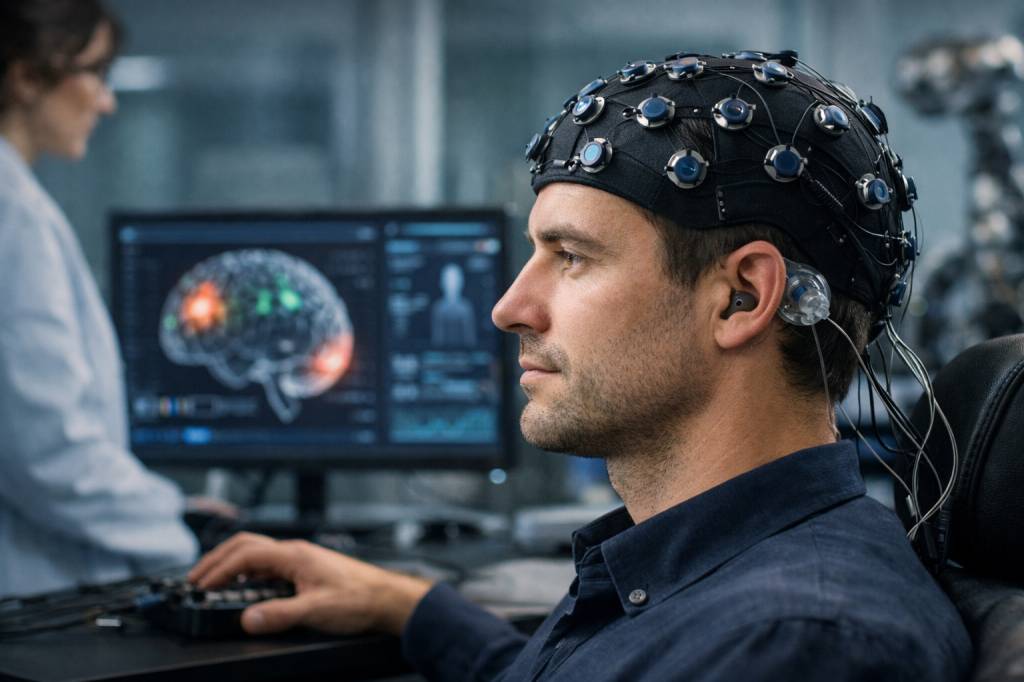
What if the most powerful interface of the future isn’t in your hand, but in your head?
Brain-computer interfaces (BCIs) are moving fast from sci-fi to engineering reality. Between Elon Musk’s Neuralink making headlines, research labs restoring movement to paralyzed patients, and startups promising “thought typing”, it’s easy to get lost between hype and actual progress.
Let’s sort that out.
In this article, we’ll explore what BCIs really are, how they work today, where they’re heading, and what human augmentation could actually mean – beyond the usual cyberpunk fantasies.
What exactly is a brain-computer interface?
A brain-computer interface is a system that creates a direct communication channel between the brain and an external device. No keyboard, no mouse, no touchscreen. Just neural activity translated into commands.
In practice, a BCI has three core steps:
- It captures brain activity (electrical or metabolic signals).
- It interprets these signals using algorithms, increasingly powered by AI.
- It translates them into actions: moving a cursor, typing text, controlling a prosthetic limb, or even stimulating the brain in return.
Today, most working BCIs are built for medicine: helping people who can’t move, speak or see. The “human augmentation” narrative – boosting cognition or giving us new senses – is more experimental, but the building blocks are already here.
The main types of BCIs: from headsets to brain implants
Not all BCIs are created equal. If you put on a plastic EEG headset, you’re not getting the same tech as a fully implanted Neuralink device. Let’s separate the main categories.
Non-invasive BCIs: the wearable route
These are BCIs that don’t require surgery. The most common technologies are:
- EEG (Electroencephalography): Sensors on the scalp pick up electrical activity. Safe, widely used, but signals are noisy and low-resolution.
- fNIRS (functional Near-Infrared Spectroscopy): Uses light to track blood flow changes in the brain. Slower but can detect cognitive states like workload or attention.
- Eye + brain hybrids: Some “BCI” systems combine EEG with eye tracking to improve accuracy.
What can they do today, realistically?
- Basic yes/no communication for severely locked-in patients.
- Simple cursor control or “mental commands” in very constrained environments.
- Attention and focus tracking (already used in some training apps, though often oversold).
Non-invasive BCIs are attractive because they’re safer and cheaper. But they hit a hard ceiling in precision. Reading thoughts? No. Reading rough intention patterns in very specific tasks? Sometimes, yes.
Invasive BCIs: surgery for signal quality
Invasive BCIs use electrodes placed directly on or inside the brain. There are different flavors:
- Intracortical implants: Tiny electrodes inserted into brain tissue. Very high resolution, but also the most invasive (Neuralink, Utah array).
- ECoG (Electrocorticography): Arrays placed on the surface of the brain, under the skull but not penetrating the tissue. A middle ground between quality and risk.
What do they enable? This is where things get impressive.
- Patients with paralysis controlling robotic arms with enough precision to drink from a cup.
- “Thought typing” at speeds above 60 words per minute in lab settings.
- Restored movement when BCIs are combined with spinal stimulators, effectively bypassing a damaged spinal cord.
But the trade-off is obvious: surgery, risk of infection, long-term stability issues (electrodes can degrade), and ethical questions that non-invasive headsets don’t raise at the same level.
From therapy to augmentation: the big shift
Most of the serious BCI work today is therapeutic. It targets:
- People with spinal cord injuries.
- Neurodegenerative diseases (ALS, for example).
- Stroke survivors.
- Severe epilepsy (monitoring and intervention).
This is important: the strongest results we have are about restoring function, not yet about enhancing healthy people. Still, the same technologies can be redirected to human augmentation.
So what could augmentation realistically look like over the next 10–20 years?
Augmenting the body: beyond prosthetics
Physical augmentation is the most intuitive use case: controlling machines as if they were part of our body.
We’re already seeing early versions of this:
- Advanced prosthetic limbs controlled by nerve or muscle signals, and more recently, by brain implants.
- Exoskeletons for rehabilitation or industrial work, where BCIs could refine control or detect fatigue.
- Wheelchairs driven by neural commands instead of joysticks or voice.
Future scenarios include:
- Wearing robotic “third arms” for complex tasks in surgery or manufacturing.
- Controlling drones or robotic systems in hazardous environments using thought-based interfaces.
- Subtle human–machine symbiosis where devices anticipate actions before we physically move.
Does this mean we’ll all have implanted chips to control our smart home? Not likely. For routine tasks, voice, touch and gesture remain far more practical. BCIs will be reserved for high-stakes zones: disability, defense, aerospace, high-precision surgery, extreme work conditions.
Augmenting the mind: memory, focus and new senses
This is where imagination runs wild: instant memory recall, direct brain-to-brain communication, “downloading” a new language in minutes. Let’s lower the volume on the sci-fi soundtrack.
Today, cognitive augmentation via BCIs is modest but promising:
- Memory prostheses: Experiments have shown that stimulating specific brain regions can improve memory performance in certain tasks (for example, in epilepsy patients with electrodes already implanted).
- Attention monitoring: Non-invasive BCIs can detect when focus drops, which could inform training systems or adaptive interfaces.
- Neurofeedback: Users learn to modulate their own brain activity to reduce anxiety, improve sleep or optimize performance, guided by EEG-based feedback.
There’s also an emerging, and fascinating, area: synthetic senses. BCIs and neural implants have already:
- Restored partial vision using retinal or cortical implants that translate camera input into patterns of stimulation.
- Added a sort of “ultrasonic sense” to animals in experiments, where they learn to detect infrared or ultrasound through new neural inputs.
For humans, that could mean one day:
- Perceiving Wi-Fi or radio signals as an extra “sense”.
- Receiving real-time data (navigation, biometrics, environment info) as subtle sensations instead of screen notifications.
Will we “download skills” like in The Matrix? No. Learning still requires structural brain changes over time. But BCIs could accelerate feedback loops, personalize training, and make some cognition support (like memory aids) feel much more integrated.
The role of AI: decoding the brain at scale
Without AI, modern BCIs wouldn’t be where they are.
Neural signals are incredibly noisy and complex. To decode their meaning, systems rely heavily on machine learning. Recent papers have used deep learning to:
- Translate brain activity into text for patients who cannot speak, with word error rates dropping significantly year after year.
- Reconstruct images a person is looking at or imagining, at a rough level, from brain scans.
- Infer emotional states or mental workload from multi-channel EEG.
The convergence is clear: better sensors + better algorithms = better BCIs.
This also raises a concern: as decoding improves, mental privacy becomes a tangible issue. Today, BCIs can’t read full thoughts. But they can infer preferences, intentions or emotional responses in controlled contexts. That’s already sensitive data.
Real-world examples: beyond the hype headlines
Let’s bring this down to earth with a few concrete examples from recent years:
- In 2021–2023, multiple research teams demonstrated brain-to-text interfaces that let paralyzed patients “type” via neural activity alone, achieving speeds close to or exceeding 60 words per minute in the best cases.
- BCI-controlled robotic arms have allowed users not only to reach and grasp, but to perform coordinated actions such as eating or drinking, with growing reliability.
- Closed-loop systems that both read and stimulate the brain have helped manage severe depression or epilepsy by intervening at the right time based on neural signatures.
- Non-invasive BCIs in gaming remain mostly experimental and sometimes gimmicky, but they have proven useful for accessibility, enabling severely disabled users to interact with digital content.
Notice a pattern: the success stories are targeted, specific and highly engineered. No telepathy. No general-purpose mind control. Just very carefully framed use cases where signal patterns are well mapped to actions.
Ethical fault lines: who controls the interface?
Whenever tech moves this close to the brain, the ethical stakes spike.
Some of the key questions we’ll have to face:
- Neurodata ownership: Who owns the raw and processed data of your brain activity? You? The hospital? The BCI vendor? This isn’t just a GDPR update; it’s a new category of intimacy.
- Security: BCIs that can stimulate or control devices cannot be treated like ordinary IoT gadgets. A “brain hack” is not your usual password leak.
- Consent over time: For implanted devices, how do you ensure that users can revoke consent, deactivate features or switch providers without another major surgery?
- Pressure and inequality: If cognitive or physical augmentation becomes a productivity advantage, will workers feel forced to adopt it to stay competitive?
Several countries and organizations are starting to talk about “neurorights”: the right to mental privacy, to personal identity, to free will, to fair access. Chile even moved toward embedding neuro-rights principles into its constitution debates.
On the corporate side, any company entering the BCI market will have to answer hard questions: not only “Can we do this?” but “Should we?” and “Who will be protected if something goes wrong?”
BCIs in everyday life: what’s realistic by 2040?
If we cut through the noise and extrapolate cautiously from current research, here’s what seems plausible by the next 10–15 years:
- Medical BCIs will be common in specialized centers: for paralysis, epilepsy, advanced prosthetics and some psychiatric conditions.
- Consumer-grade non-invasive BCIs will be integrated into headsets, AR glasses or gaming devices, but mostly as supplementary input, not mind-reading magic.
- Workplace augmentation will be explored in safety-critical fields (pilots, surgeons, firefighters) using BCIs to monitor fatigue and cognitive overload.
- Regulations around neurodata and implantable tech will tighten, especially in Europe and parts of North America.
And what is less realistic in that same timeframe?
- Full-blown brain-to-brain communication for everyday use.
- Instant learning via “skill uploads”.
- Mass-market brain implants for healthy people, sold like smartphones.
The limiting factors aren’t just technical. They’re also surgical risk, cost, regulation, and something often underestimated: user tolerance. Many people don’t like wearing a VR headset for more than an hour; imagine asking them to get a brain implant for productivity.
How to prepare: skills and questions for the BCI era
Even if you never wear a neural implant, BCIs will impact the broader digital ecosystem. A few practical angles:
- Developers & engineers: BCIs need robust software, UX for new input modalities, and secure cloud infrastructures for neural data. Backgrounds in signal processing, ML, and human–computer interaction will be highly relevant.
- Designers: A new generation of interfaces will have to be forgiving to noisy, probabilistic input. Think error-tolerant, adaptive, multimodal UI.
- Policy and ethics professionals: Neurotechnology is a wide-open field for legal and ethical frameworks. From insurance to labor law, everything will need updates.
- Curious users: Understanding the basics – invasive vs non-invasive, therapeutic vs augmentation – will help you separate marketing claims from meaningful progress.
Three questions worth keeping in mind whenever you see a bold BCI announcement:
- Is this peer-reviewed research or just a demo video?
- Is it about decoding general thoughts or very specific patterns in a tightly controlled task?
- Does it require brain surgery, or is it a headset? The risk profile changes everything.
Human augmentation: power, limits and trade-offs
BCIs won’t magically transform humans into omniscient cyborgs. But they will gradually redraw the boundary between what we can delegate to machines and what stays inside our biological envelope.
In concrete terms, we’re heading toward a world where:
- Disability and impairment are increasingly addressed by direct neural interfaces.
- Professionals in demanding environments can rely on tighter human–machine loops for decision support and control.
- Some early adopters will experiment with new kinds of perception and cognitive support, testing the edges of what “normal” human capabilities mean.
The central question isn’t just “What can BCIs do?” but “What do we want to use them for?” To restore, to optimize, to control, to profit? The technology is neutral; the deployment is not.
As always with emerging tech, the best strategy is a mix of curiosity and skepticism. Follow the data, ask for details, and resist both dystopian panic and utopian hype.
Because the future of human augmentation won’t be defined by a single chip in the brain, but by thousands of choices around design, access, security, and ethics.
And that part, at least, is still very much in our hands.
— Lili Moreau