


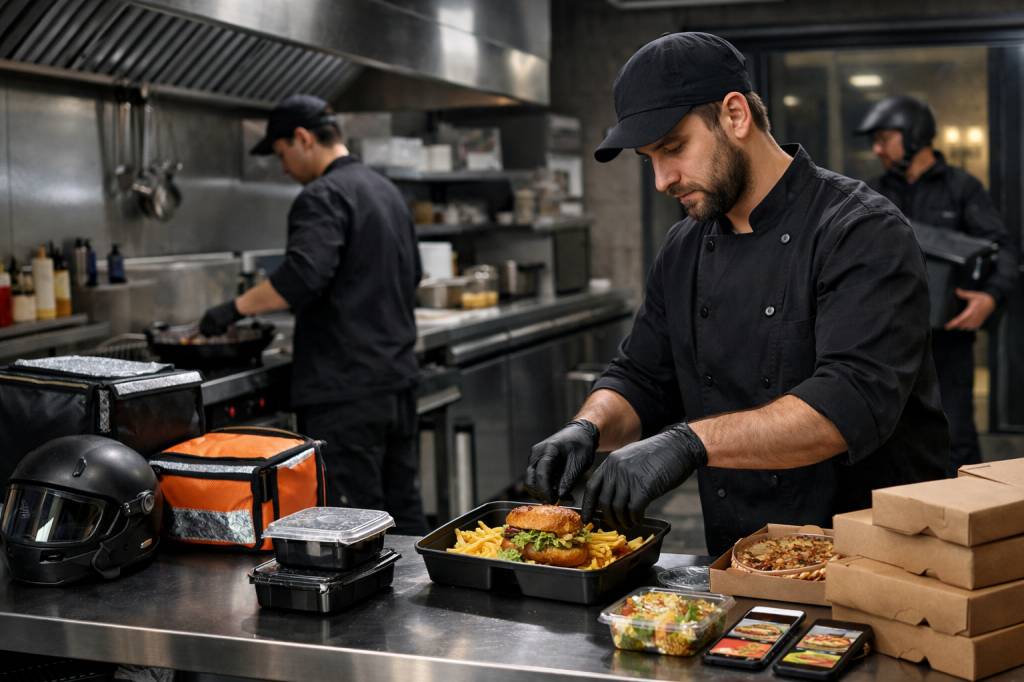
Ten years ago, food delivery meant a stack of paper menus and a phone call. Today, you can order a vegan poké bowl at 11:37 p.m. from a “restaurant” that doesn’t exist on any street — only in an app. Welcome to the world of dark kitchens and delivery platforms, where food is data, logistics is king, and the restaurant as we know it is being rewritten.
What exactly is a dark kitchen?
A dark kitchen (also called ghost kitchen, cloud kitchen or virtual kitchen) is a professional cooking space designed only for delivery. No dining room, no waiters, no street-facing sign. Just a production line, a delivery app, and a stream of tickets on a screen.
In practice, it can take several forms:
- Dedicated dark kitchens – Warehouses or industrial spaces converted into multiple kitchen units, each hosting one or several “brands”.
- Hidden backroom kitchens – A traditional restaurant using a separate kitchen line to operate additional delivery-only brands.
- Shared facilities – Spaces rented “by the station” to multiple micro-restaurants, often managed by a platform or operator.
On your app, you see ten different “restaurants”. In reality, your burger, ramen, salad and bubble tea might all come from the same corridor in a warehouse on the edge of the city.
Why delivery apps love dark kitchens (and vice versa)
For delivery platforms like Uber Eats, Deliveroo, DoorDash or Glovo, dark kitchens solve a simple problem: demand is high, but good locations and full-service restaurants are expensive and slow to scale. Virtual kitchens, on the other hand, are software-native. You can spin up a new “brand” almost as easily as launching a website.
From the platforms’ point of view, dark kitchens offer:
- More supply, more often – New concepts can appear in days, fine-tuned by real-time data: order times, basket sizes, ratings, re-order rates.
- Higher control – Some platforms co-own or operate the kitchens, tightening their grip on pricing, promo strategies and customer data.
- Algorithmic optimization – Menus are shaped by search terms and click-through rates, not just a chef’s intuition.
For operators, the attraction is just as strong:
- Lower fixed costs – No dining room, cheaper locations, minimal front-of-house staff.
- Faster experimentation – Test a new cuisine under a new brand with almost no marketing cost: the app becomes your storefront.
- Scalability – Replicate the same brand in multiple cities using a shared playbook, standardized recipes and centralized procurement.
In other words: dark kitchens are the SaaS version of restaurants. Flexible, scalable, data-driven — and highly dependent on the platform layer.
The economic reality: who actually makes money?
The sleek marketing hides a harder question: when everyone takes a cut — platform, courier, kitchen operator, brand owner — what’s left?
Let’s break it down simply. A typical delivery order might look like this:
- Customer pays: €25 (food + delivery fees + service fees)
- Platform takes: 20–35% commission on food value, plus fees
- Courier receives: a small fixed fee + variable per km (often under €5 per delivery in many markets)
- Kitchen pays: rent, staff, food costs, packaging, utilities, equipment
Margins are thin. Many dark kitchen brands rely on:
- Volume – Very high order throughput to compensate low profit per order.
- Cross-brand synergy – Using the same ingredients across multiple “virtual brands” to optimize stock.
- Menu engineering – Pushing high-margin items using photos, combos and app placement.
Some impressive success stories exist, but behind them, there are also plenty of quiet closures and abandoned industrial kitchens. This is not an easy-profit industry. It’s logistics under pressure.
What this means for your dinner: the user experience shift
From the consumer side, dark kitchens and apps are changing not just how we eat, but how we think about food.
1. Convenience first, identity later
Most users search by craving or category: “sushi”, “pizza”, “Thai”. Brand loyalty is weaker than in traditional hospitality. If a new “Tokyo Street Sushi” appears with 4.7 stars and nice photos, few people ask: who is behind this? Is it a new chef, or the same operator running five other “Japanese” brands from one kitchen?
2. Packaging and UX are the new decor
We once judged a restaurant by its atmosphere, the playlist, the energy of the room. Now, we judge:
- How the food survives a 20–35 minute ride.
- The clarity of the menu in-app.
- The accuracy of ETA predictions.
- The squeeze of the sauce bottle and the quality of the recyclable box.
Experience has moved from “on-site” to “on-screen and on-couch”. That’s a major psychological shift.
3. Data decides what appears on your plate
Your feed in a delivery app is not neutral. It’s ranked and filtered based on:
- Your past orders and timings.
- Which brands are paying for sponsored placement.
- Estimated preparation time and courier availability around you.
Food is no longer just a creative act; it’s an output of recommendation engines and operational constraints. Your “spontaneous” craving often meets a highly curated catalog.
Health, cities, and workers: the invisible bill
Beyond comfort and choice, there’s a social and urban cost we’re only beginning to measure.
Impact on public health
On-demand food skews towards what travels well and sells fast: burgers, fried chicken, pizzas, sugary drinks. Platforms are adding healthier and plant-based options, but the core business still thrives on high-calorie, high-margin formats.
Add to that:
- Late-night availability.
- One-tap reordering of your “usual”.
- Promotions that reward bigger baskets.
And you get a food environment optimized for temptation, not long-term health.
Impact on urban life
Dark kitchens often cluster in low-visibility areas, but their activity spills into cities:
- Traffic from couriers waiting or circling.
- Noise and waste management issues for nearby residents.
- Pressure on traditional restaurants that pay for prime locations and full staff.
Some cities are starting to react: stricter zoning rules, caps on the number of dark kitchens in certain districts, or requirements for transparency on where food is actually prepared.
Impact on delivery workers
Most riders operate as independent contractors, paid per drop, heavily managed by algorithms. Dark kitchens contribute to:
- More orders in shorter time windows, increasing pressure.
- Higher volatility: bursts of demand during peak hours, dead time outside them.
- Risk transfer: couriers shoulder weather, traffic, and accident risks with limited protections.
Regulation is catching up slowly, but it’s not yet aligned with how fast the market is scaling.
Will traditional restaurants disappear?
No — but they will have to choose their battles.
Full-service restaurants still own what dark kitchens can’t replicate:
- A physical atmosphere and social experience.
- Direct relationships with customers.
- An emotional connection to place: the “neighborhood spot” effect.
However, many restaurants are already hybridizing:
- Launching one or two virtual brands from their existing kitchen to optimize off-peak hours.
- Using delivery as a marketing channel: discovery online, loyalty in person.
- Reworking menus around “on-premise” vs. “delivery-optimized” dishes.
The future is less “dark kitchens vs. restaurants” and more a spectrum:
- Pure dine-in places, sometimes proudly “no delivery”.
- Hybrid restaurants with both room and a serious delivery operation.
- Pure virtual brands with no intention to ever serve on site.
Each model will need to be clear about what it offers and why it exists — beyond “it’s available on an app”.
Tech trends shaping the next wave
Dark kitchens are only the first iteration. Several trends are already probing what comes next.
Automation and robotics
From burger-flipping robots to automated fryers and salad-assembling machines, repetitive kitchen tasks are prime candidates for partial automation. The goals are clear:
- Reduce labor costs in tight-margin operations.
- Standardize quality and speed at scale.
- Extend operating hours without burning out staff.
Don’t expect “fully robotized” restaurants everywhere tomorrow — but expect more semi-automated dark kitchens where humans supervise flows, customize orders, and manage exceptions.
Smarter demand prediction
AI models already help forecast when and where orders will spike so that:
- Ingredients are prepped more precisely, reducing waste.
- Couriers are positioned closer to expected hotspots.
- Dynamic pricing adjusts fees based on demand and availability.
As models improve, your city’s food network will start to look disturbingly like an optimized cloud infrastructure: auto-scaling kitchens, load balancing across brands, predictive “pre-cooking” during big events or bad weather.
New formats: from meal kits to semi-prepared food
One interesting middle ground is emerging: not just “ready-to-eat now”, but also:
- Pre-portioned kits you finish at home in 10–15 minutes.
- Par-cooked components that combine speed with fresher texture.
- Batch-cooked, reheatable meals optimized for the fridge or freezer, ordered in weekly plans.
Dark kitchens can easily pivot into these formats using the same infrastructure, especially if consumer behavior shifts towards “convenient but slightly more involved than opening a box”.
Where does regulation fit in?
As dark kitchens and apps recreate the food system in software, regulators are playing catch-up.
We’re starting to see questions like:
- Should delivery-only operations be clearly labeled as such in apps?
- What transparency is required about location, hygiene controls and ownership of brands?
- How should cities zone and limit dark kitchen density in residential areas?
- What minimum protections should apply to riders beyond current contractor models?
Some jurisdictions have responded with:
- Licensing requirements specific to ghost kitchens.
- Rules on how apps display sponsored placement and ratings.
- Collective bargaining rights or minimum pay guarantees for couriers.
Expect more friction here. The future of food is not only technical and logistical; it’s also deeply political.
How to navigate this new food ecosystem as a consumer
We are not powerless in this transformation. A few simple habits can make your digital food choices more aligned with your values.
- Check the “About” or website links of the brands you order from. Many virtual brands are transparent if you take 30 seconds to look.
- Alternate between delivery and on-site visits for the places you really like. In-person spending often supports them better.
- Watch your “default choices”. That one burger you reorder at midnight every week? It didn’t become a habit by accident.
- Try non-obvious categories in the app: local grocery, meal kits, or healthier formats if available.
- Be mindful of ratings. One bad review on delivery (cold fries, late courier) doesn’t always reflect the kitchen’s real quality.
Ultimately, every tap is a vote — for a certain type of city, a certain type of work, and a certain type of relationship to food.
What’s really at stake in the “future of food”?
Dark kitchens and delivery apps are not just a trend for urban millennials who don’t like cooking. They’re a test case for a broader shift: what happens when a deeply physical, sensory, social activity — eating together — is re-architected around software, logistics and platforms.
The risk is obvious: more isolation, more ultra-processed calories, more precarious labor on bikes, more anonymous brands optimized for click-through rates. But there is also an opportunity: smarter supply chains, less waste, new culinary concepts that would never survive in a high-rent main street, more inclusive options for people who can’t easily eat out.
The difference between those two futures will not be decided only in the boardrooms of delivery unicorns. It will be negotiated plate by plate, policy by policy, and app update by app update.
If we want a food system that stays human while becoming more digital, we’ll need three things:
- Operators who see tech as a tool, not a replacement for craft and care.
- Regulators who understand algorithms as well as hygiene standards.
- Consumers who stay curious about what’s behind the glossy photos in their feed.
Food has always been about more than calories: it’s identity, culture, and connection. The question facing us now is simple, but urgent: in a world of dark kitchens and frictionless delivery, how do we keep all of that alive — without giving up the comfort of ordering dinner in two taps?
— Lili Moreau