


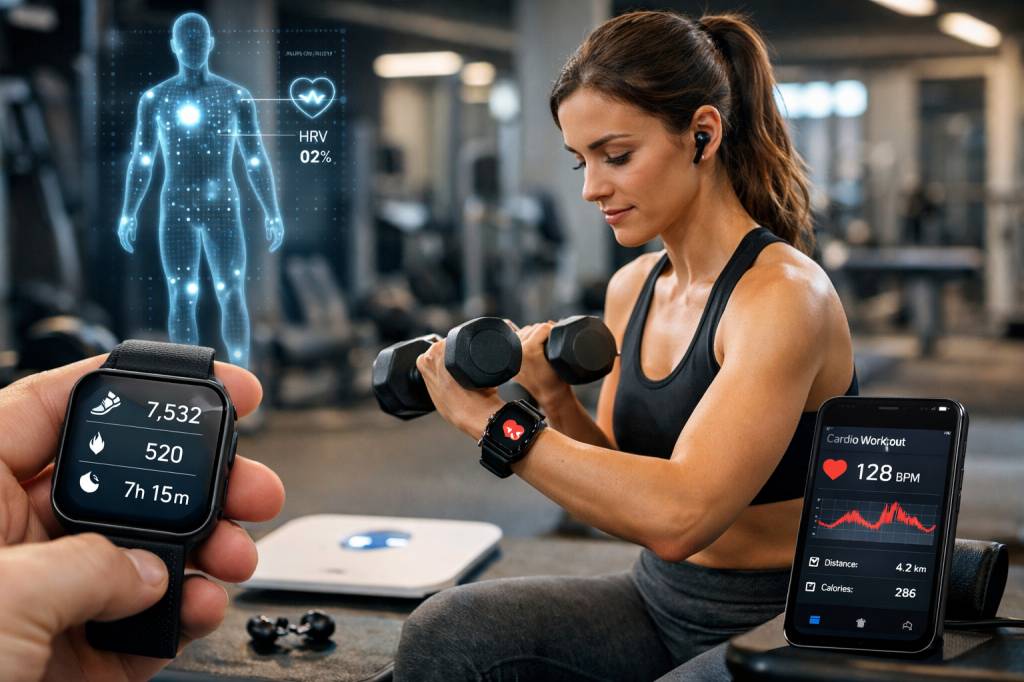
Fitness tech used to mean a plastic step counter and a dusty exercise DVD. Today, your watch guesses when you’re stressed, your phone tells you how badly you slept, and your fridge might soon negotiate your snack choices. The big difference? Artificial intelligence now sits at the center of health tracking – quietly analyzing, predicting, and nudging your behavior in the background.
But is AI really making us healthier, or just drowning us in more charts and colorful dashboards? Let’s unpack what’s changing, what’s hype, and how to actually use these tools without becoming a quantified-zombie.
From step counters to prediction engines
Wearables started simple: count steps, show a graph, send a notification if you’ve been sitting for six hours straight. That era is over. Modern devices are shifting from tracking what happened to predicting what might happen next – and that’s where AI comes in.
Today’s AI-driven fitness tech can:
- Spot anomalies in your heart rate or sleep patterns before you feel anything.
- Estimate VO2 max, recovery time, and training readiness without a lab test.
- Adapt your workouts on the fly based on how your body responds, not what’s on a static plan.
- Combine multiple signals – heart rate variability, temperature, breathing rate, movement – to detect early signs of illness or overtraining.
Under the hood, these systems run machine learning models trained on millions (sometimes billions) of data points gathered from other users. The more people use the devices, the better the algorithms get at spotting patterns that humans or simple formulas would miss.
AI-powered wearables: what’s actually new?
Not all “AI” labels on gadgets mean much. But some real shifts are worth noting.
Modern health wearables increasingly use AI to:
- Clean up noisy sensor data – Your wrist doesn’t always sit perfectly still, your skin gets sweaty, the band moves. AI models filter out movement artifacts to get usable heart rate and HRV data.
- Personalize baselines – Instead of comparing you to a generic “healthy adult”, systems learn what’s normal for you over time. A slightly elevated heart rate might be fine for one person but a red flag for another.
- Detect irregular heart rhythms – Several smartwatches can now flag potential atrial fibrillation using on-device algorithms approved in certain regions by health authorities.
- Estimate energy expenditure – Still imperfect, but AI helps reduce the massive errors of old calorie counters by learning from large labeled datasets.
This move toward individualized modeling is crucial. Your data is no longer just plotted on a generic curve; it trains a mini-model of your physiology. That’s where the tech starts to be more than just a fancy stopwatch.
Smart coaching: AI as your pocket trainer
Health tracking is only useful if it changes behavior. That’s the Achilles’ heel of most dashboards: beautiful charts, zero action. AI is now trying to close that gap by acting as a coach rather than just a recorder.
Typical AI coaching features include:
- Adaptive workout plans that adjust intensity and volume based on your recent sleep, stress, and performance data.
- Real-time feedback on your running pace, posture (via motion sensors), or heart rate zones, with instant corrections.
- Goal-based programs (“run a 10K in 8 weeks”, “lose 5kg steadily”) where the algorithm tweaks your plan daily.
- Motivational nudges delivered at calculated “high-impact” times, when you’re most likely to say yes to a workout.
Some apps are already surprisingly good at this. Miss two runs? The plan softens, then ramps up again. Sleep badly? Intensity drops, with a suggestion to switch to a walk or mobility session. These systems blend physiological data with behavioral patterns to keep you at the edge of challenge without tipping into burnout.
Of course, they’re far from perfect. Most AI coaches still ignore basic context like “I had a terrible workday” or “I’m traveling and eating airport food”. But the general direction is clear: your training plan is becoming a living, adaptive system instead of a PDF you forget after week three.
Beyond steps: AI and “whole-person” health
Fitness isn’t just about workouts. Sleep, nutrition, mental health, hormones, medication, environment – they all shape performance and well-being. New AI tools try to stitch these layers together.
We’re seeing:
- Sleep scoring + daytime recommendations – Poor REM phase? Your app suggests cutting caffeine, advancing bedtime, or dialing down intensity that day.
- Stress detection from heart rate variability and breathing patterns, nudging you toward breathing exercises, short walks, or screen breaks.
- Cycle-aware training for women, with AI adjusting workloads based on menstrual cycle phases and reported symptoms.
- Nutrition suggestions linked to activity: recommending protein targets post-workout or flagging under-fueling based on your training load.
This “whole-person” trend is promising. Instead of obsessing over one metric (hello, step counts), you start to see trade-offs: a brutal late-night workout might crush tomorrow’s productivity and sleep. AI can surface those cause–effect links faster than your trial-and-error experiments.
Real-world impact: what changes in everyday life?
So what does this look like on a normal Tuesday, not in a product marketing video?
Typical real-world scenarios:
- You wake up and your app suggests: “Your recovery score is low. Swap today’s intense run for light mobility and a walk.” You follow it. Two years ago you would have powered through and wondered why you felt awful for three days.
- Your wearable notices a higher-than-usual resting heart rate and lower HRV for three mornings in a row. You get a subtle message: “You may be fighting something. Prioritize sleep and hydration.” Two days later, a cold hits – but lighter than usual.
- You start a strength program. The AI tracks your performance and auto-adjusts weights and rest times based on how quickly you complete sets and how your heart rate responds.
- Your company offers an AI coaching app. It nudges you to move between meetings, suggests short breathing exercises before big presentations, and flags long-term burnout risks based on your patterns.
None of this is magic. Most recommendations are just good coaching translated into algorithms. The upside: you get that support consistently, 24/7, at scale, and at a cost that’s a fraction of human coaching.
Where AI shines… and where it still fails
Despite the hype, it’s worth separating what AI does well from what remains very shaky.
AI is genuinely strong at:
- Pattern recognition – spotting subtle changes across thousands of data points over weeks or months.
- Consistency – it doesn’t forget to remind you to move, drink water, or wind down before bed.
- Personalization at scale – adapting recommendations for millions of users simultaneously.
- Noise filtering – cleaning up imperfect signals from cheap sensors.
AI is still weak at:
- Context – it usually doesn’t know about your sick kid, job crisis, or jet lag unless you tell it explicitly.
- Nuanced motivation – it can’t truly understand why you avoid a certain activity or how your relationship with food or exercise was shaped.
- Edge cases – people with chronic illnesses, atypical physiology, or medications that distort standard signals.
- Long-term behavior change – nudges help, but they don’t rewrite deep habits or beliefs by themselves.
The result: AI is an excellent assistant coach, a decent junior trainer, and a terrible psychologist. Using it wisely means knowing where its competence stops.
The other side: privacy, bias and commercial pressure
AI health tracking is not a neutral toy. It operates in a dense web of incentives, regulations, and ethical challenges.
Privacy is the obvious one. Your heart rate, sleep cycles, sometimes even raw ECGs and location data are highly sensitive. Yet many fitness apps monetize anonymized (and sometimes not-so-anonymized) data via partnerships and advertising. Reading the privacy policy is no longer optional if you care where your biometrics end up.
Then comes bias. Most algorithms are trained on specific populations – often young, relatively healthy, and from limited geographical regions. That can produce misleading insights for older users, women (historically underrepresented in clinical and performance data), or people with chronic conditions.
Finally, there’s commercial pressure. Some apps and gadgets are designed around engagement, not health. Daily streaks, aggressive notifications, and leaderboards are great for time-on-app; not always great for rest, mental health, or a healthy relationship to movement.
If your watch is making you anxious instead of empowered, the tech is working against you – no matter how “smart” the algorithms are.
Practical tips: using AI fitness tools without losing your sanity
The question isn’t just “Is the AI good?” but “How do you make it serve your goals instead of the other way round?” A few practical guardrails help.
- Pick 2–3 core metrics you care about (for example: weekly active minutes, sleep duration, and recovery score) and ignore the rest. More data doesn’t always mean more clarity.
- Use trends, not single numbers. One bad night of sleep or a random spike in heart rate isn’t a story. Two weeks of gradual change might be.
- Turn off 80% of notifications. Keep only what drives action (e.g., “time to wind down for sleep”) and ditch what creates noise (“you’re behind your friends!”).
- Apply the “common sense check”. If your body and brain scream “no” but your app says “green light, go hard!”, trust your body first.
- Protect your privacy. Check data-sharing settings, avoid logging hyper-detailed medical info in apps with vague policies, and be wary of connecting everything to everything “just because”.
- View AI as a second opinion, not a command. Let it challenge your intuition, not replace it.
What’s coming next in AI-driven fitness?
We’re still early in this story. Several emerging trends suggest the next wave of change.
- Continuous non-invasive monitoring – Research is advancing on wearables that could estimate blood glucose, hydration, or lactate without needles. If AI can interpret these signals reliably, training and nutrition personalization will jump to a new level.
- Multimodal models – Systems that combine movement patterns (video or motion sensors), language (your logs), and biometrics into a single model of your health and performance.
- On-device AI – More processing happening directly on your watch or ring, reducing latency and limiting the need to send raw data to the cloud.
- Clinical-grade integrations – Bridges between consumer fitness tech and healthcare systems, allowing your doctor (with your consent) to see long-term patterns instead of a 10-minute snapshot in their office.
- Emotion-aware coaching – Early experiments use voice tone, typing patterns, or facial cues to estimate mood and adjust recommendations. The potential is big; the ethical questions are even bigger.
The direction is clear: more data, more personalization, more automation. The open question is whether regulation, design ethics, and user education will keep pace.
How to choose the right AI fitness ecosystem for you
If you’re thinking “Where do I even start?”, narrowing your options helps. Instead of chasing the “smartest” AI, focus on alignment with your lifestyle and values.
Key criteria to consider:
- Your primary goal – General health? Performance in a specific sport? Weight management? Stress reduction? Different tools optimize for different outcomes.
- Hardware comfort – Wrist, ring, patch, phone-only? If you hate wearing it, even the best AI won’t help.
- Data transparency – Does the app explain metrics in clear language? Can you see how scores are calculated, at least conceptually?
- Privacy posture – Clear policies, granular control, minimal data sharing by default. If this information is hard to find, that’s already an answer.
- Integration – Does it play nicely with your existing tools (calendar, health record apps, smart scale, etc.) or create yet another silo?
- Signal vs. noise – Does the app help you act, or just show endless graphs? Look for clear, actionable suggestions tied to your data.
Think of it less as buying a gadget and more as choosing a long-term partner in your health decisions. You’re handing it data; it should give you clarity in return, not dependency or anxiety.
AI, health, and the right kind of control
AI has quietly shifted the power balance of health tracking. For the first time, individuals can access insights that used to require labs, coaches, or clinics. That’s a genuine democratization of health intelligence.
But more insight doesn’t automatically lead to better outcomes. The real win is not a perfect recovery score; it’s understanding how your body responds to life and being able to adjust in real time, without becoming obsessive.
If there’s a useful mindset to adopt, it’s this: let AI handle the boring pattern-spotting so you can focus on decision-making. Your watch can crunch the data. Only you can decide that tonight, the smartest move is to skip the late emails, put the phone away, and actually sleep.
When used on those terms – as a powerful assistant, not a commander – AI-driven health and fitness tech stops being another source of pressure and starts becoming what it should always have been: a tool to help you live in your body with a bit more understanding, and a bit less guesswork.
And if one day your fridge does try to negotiate your snack choices? At least you’ll know which side of the argument has the data advantage.