


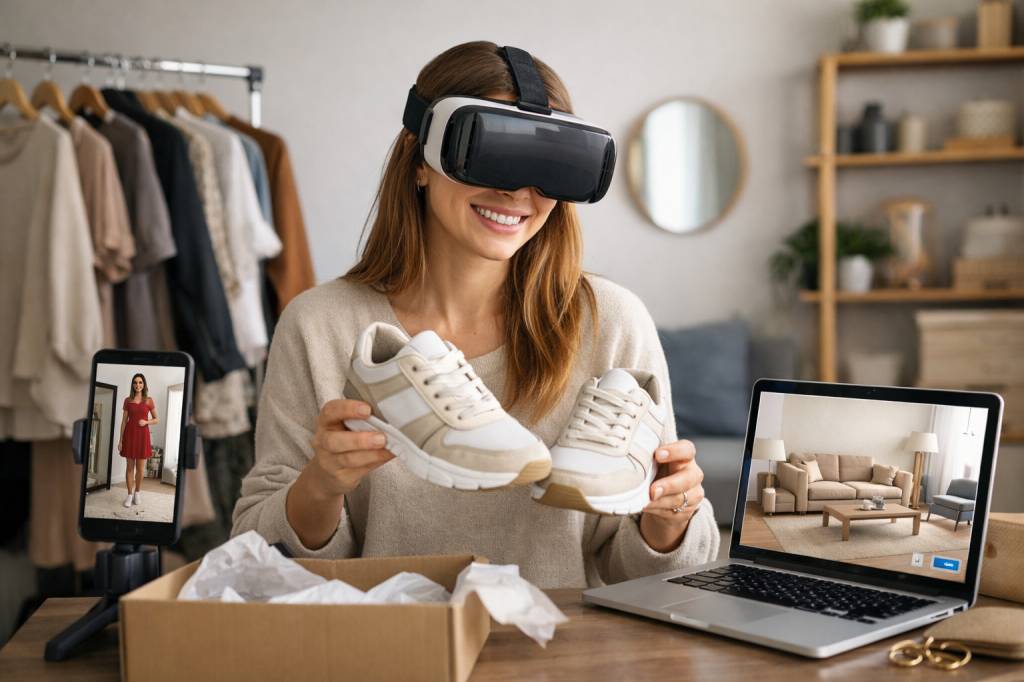
From Flat Screens to Immersive Journeys: AR & VR Enter the Checkout
Scroll, click, add to cart. For years, online shopping has looked more or less the same: static photos, a product description, quelques avis, and a bit of guesswork.
AR (augmented reality) and VR (virtual reality) are quietly breaking that pattern. They’re turning e-commerce from a 2D experience into something immersive, interactive, and—when it’s done right—much more useful than a traditional product page.
Is this just another buzzword wave, or are we looking at the next standard of online retail? Let’s look at how AR and VR are already changing the way we browse, test, and buy.
AR vs VR: What Actually Changes for Shoppers?
Before talking use cases, it’s worth clarifying what we’re dealing with—because “immersive tech” tends to become a catch-all term.
Augmented Reality (AR) adds digital elements to the real world. You use your smartphone camera or AR glasses to see products “overlaid” in your environment.
- Try-on filters for glasses, makeup, sneakers
- “View in your room” for furniture or décor
- Instruction overlays for assembling or using products
Virtual Reality (VR) places you inside a fully digital environment via a headset.
- Virtual shops you can walk through
- 3D showrooms for cars, real estate, or luxury goods
- Immersive brand experiences and events
In short:
- AR solves the “Will this fit here / on me?” problem.
- VR tackles the “Can you recreate the in-store experience online?” challenge.
Try-Before-You-Buy, Without the Dressing Room
Ask any e-commerce manager what hurts the most and you’ll often get the same answer: returns.
Clothing, shoes, furniture and décor have some of the highest return rates, often between 20% and 40% depending on the sector. The reasons are predictable: wrong size, wrong color, doesn’t look like the photo, doesn’t fit the space.
AR doesn’t magically erase all of that, but it attacks the core uncertainty.
Fashion and accessories
- Glasses & sunglasses: Warby Parker and Ray-Ban let you “try on” frames via your smartphone camera. The app maps your face and adjusts the frame size and angle in real time.
- Makeup: L’Oréal’s ModiFace tech (also used by brands like Maybelline) lets you test lipstick, eyeshadow, and foundation shades on your own face. No tester, no wipes, no bathroom mirror required.
- Sneakers & streetwear: Nike and Gucci have both experimented with AR try-ons for shoes—point your camera at your feet and watch the model switch instantly.
Result? According to several retailers, AR try-on tools can:
- Boost conversion rates by 10–30% on the products where they’re deployed
- Reduce return rates for those items by 5–20%, depending on the category
Furniture and home décor
Here, AR is almost a no-brainer. You point your phone at your living room and drop in a 3D model of a sofa or a lamp, at scale, in your space.
- IKEA Place: One of the first mass-market AR apps, allowing customers to visualize over a thousand products at home.
- Amazon’s “View in your room”: Integrated directly into product pages for furniture, décor, and some electronics.
These tools reduce the classic “this looked smaller online” drama and the “we can’t open the door because of this stupid cupboard” scenarios.
From Product Pages to 3D Playgrounds
Beyond try-ons, AR and VR change how products are presented in the first place.
3D product models
Instead of moving through five or six photos, users interact with a single 3D model:
- Rotate the product 360°
- Zoom in on textures, seams, ports, finishes
- Toggle colors and configurations in real time
Brands like Samsung, Apple and car manufacturers increasingly use interactive 3D views for flagship products. The logic is simple: the more angles users see, the fewer unpleasant surprises upon delivery.
Interactive demos instead of static manuals
VR and AR are also becoming tutorial tools:
- AR overlays that guide you through setting up a router or assembling a piece of furniture, step by step
- VR walkthroughs for complex devices (think: industrial machines, high-end appliances, or even cars)
For complex or expensive products, this adds an extra layer of reassurance before purchasing: the buyer can actually see themselves using the item, not just reading about it.
Virtual Stores: Hype or Real Value?
Let’s be honest: early “virtual stores” often felt like a 2003 video game with less fun and more friction. Slow to load, hard to navigate, and less efficient than a plain search bar.
But not all VR commerce is doomed. The value appears when brands use VR for what it does best: immersion, storytelling, and presence.
Examples in the wild
- Car showrooms: Audi, BMW and other manufacturers have used VR to let customers explore car interiors, change options, and “sit” inside models not physically available at the dealership.
- Luxury and fashion: Some brands have built VR showrooms or catwalk replays where users can browse collections in an experiential way before clicking through to standard product pages.
- Real estate: Virtual tours are now standard in many markets, and they’re essentially a VR-lite experience available via the browser or headset.
So who actually benefits?
- High-involvement products: Cars, real estate, high-end furniture or design pieces—items that justify spending 20–30 minutes inside an immersive environment.
- Brands that sell a universe, not just objects: VR supports storytelling: world-building, events, guided visits, backstage access, interactive campaigns.
For everyday essentials? Most users still prefer speed over immersion. Nobody needs a VR headset to buy toothpaste.
Why Shoppers Engage More with AR and VR
Beyond the “wow” effect, AR and VR tap into some very concrete psychological levers that impact purchase decisions.
More control, less risk
AR lets users test scenarios that would be annoying, expensive or impossible in real life:
- Does this color of paint work with my current floor?
- Will this plant look ridiculous next to that sofa?
- If I choose this size TV, will it dominate the room?
Each question answered via AR reduces perceived risk—which often blocks the “Add to cart” click.
Sense of ownership before buying
Psychologists talk about the “endowment effect”: we value things more once we feel they’re ours. Trying a couch in your living room via AR is a small step in that direction. You’ve already seen it at home. Mentally, it’s harder to let go.
Stronger memory traces
Immersive experiences are simply more memorable than scrolling through thumbnails. For brands fighting for attention in crowded feeds, staying top-of-mind is already a win—even if the purchase happens days later.
The ROI Question: Do AR and VR Really Pay Off?
Tools and content creation for AR/VR are not free, especially if you want high-quality 3D models and smooth experiences. So the natural question is: is it worth it?
Some indicative performance trends from early adopters
- Higher conversion: Brands report conversion uplifts from 10% to 40% on products with AR visualization compared to those without.
- Reduced returns: In furniture and décor, reductions around 20% are not uncommon when AR “view in room” is available.
- Increased engagement time: 3D/AR content can multiply time spent on a product page by 2–3x, especially for high-value items.
Of course, numbers vary widely depending on the category, the target audience, and—crucially—the execution quality. A clunky AR viewer will not save a bad product page.
Hidden benefits
- Rich data: AR and VR interactions generate behavioral data: which angles users explore, which options they test, what they virtually try on and then buy (or abandon).
- Brand positioning: For some sectors, offering good AR/VR experiences signals innovation and quality—useful in competitive markets where products are otherwise similar.
Tech and UX: What Needs to Be in Place
On paper, everything sounds promising. In practice, AR/VR commerce fails fast when basic constraints are ignored.
Friction is the enemy
Every additional step kills adoption. Requiring a separate app download, forcing a headset, or hiding the AR button in a submenu is a recipe for low usage.
Best results usually come from:
- Direct integration into product pages (“View in your room”, “Try it on” clearly visible)
- Web-based AR (WebAR) that works in the browser with no install
- Instant loading—ideally under 2–3 seconds for the first experience
Quality of 3D models matters
Low-resolution models, incorrect scaling, or unrealistic colors destroy trust rather than build it. If the AR couch looks nothing like the real one, you’ve just built a very fancy disappointment machine.
- Textures and colors must be faithful to the physical product
- Scale must be accurate (especially for furniture and décor)
- Lighting should be realistic enough to avoid the “plastic toy” effect
Device and network constraints
Not everyone has the latest iPhone or a fiber connection. Good AR/VR commerce experiences are:
- Optimized for mobile performance (file size, compression, loading strategy)
- Graceful under poor connectivity (progressive loading, fallbacks)
- Usable without a headset (for VR-like experiences, think 360° tours via browser)
Privacy, Data and the “Creepy” Factor
As soon as cameras and 3D mapping are involved, another topic emerges: what happens to the data?
Room scans and faces are sensitive
- AR that scans your room to place furniture technically captures part of your home layout and objects.
- Virtual try-on tools analyze your facial features, which can be considered biometric data depending on the implementation and jurisdiction.
From a user perspective, the key questions are:
- Is any of this data stored? Where and for how long?
- Is it linked to my identity or used for profiling?
- Can I opt out easily?
From a brand perspective, transparency is non-negotiable. Clear disclosures, minimal data retention, and compliance with regulations (GDPR, etc.) are not just legal constraints—they’re trust enablers.
Metaverse, Mixed Reality and the Next Layer
We can’t talk about AR/VR commerce without touching on the buzzword that dominated 2021–2022: the metaverse.
The hyper-ambitious vision of fully persistent virtual worlds where we work, socialize and shop has cooled down, but some underlying trends remain relevant for e-commerce.
Digital twins and hybrid commerce
- Brands create digital twins of their physical products: 3D versions used for AR, VR and marketing content.
- Those same assets can appear in games, virtual worlds or “metaverse-lite” platforms, sometimes linked to real purchases (buy the sneaker in-game, unlock a physical pair or vice versa).
Mixed reality devices
New headsets (Apple Vision Pro, Meta Quest 3, etc.) are betting heavily on mixed reality: overlaying digital content on the real world through more comfortable, high-resolution devices.
For commerce, this could mean:
- Browsing products as large 3D objects in your room
- Comparing items side-by-side at real scale
- Attending mixed-reality product launches with direct purchase options
We’re not there yet at mass scale—headsets are still too expensive and niche for everyday shopping. But from a tech and content standpoint, the work done today on AR assets directly feeds into that future.
Practical Tips for Brands Considering AR/VR Commerce
If you’re on the brand or tech side and wondering where to start, a few pragmatic guidelines can help avoid burning budget on the wrong experiments.
- Start with products where visualization solves a real pain point. Furniture, décor, glasses, cosmetics, home appliances—anything where size, fit or aesthetic integration matters.
- Integrate AR where users already are. Inside product pages, existing apps, or directly in the browser. Avoid forcing app downloads just for one feature.
- Measure everything. Track usage of AR/VR features, impact on conversion, time on page, return rates. If you’re not seeing any lift, improve execution or reconsider where you deploy it.
- Don’t try to “VR-ify” your entire shop. For now, VR works best as a premium layer for specific categories or campaigns, not as the universal shopping interface.
- Invest in content quality. A smaller catalog of high-quality 3D assets beats a huge catalog of mediocre models.
What This Means for Shoppers
On the user side, AR and VR have a simple promise: fewer unpleasant surprises and more confidence before hitting “Pay now”.
We’re moving from guessing based on photos to testing in context:
- Will this sofa actually fit in the corner and match the rug?
- Does this lipstick shade make me look awake or like I stayed up three nights in a row?
- Is this 55-inch TV perfect… or way too big?
As these tools become more common, expectations will rise. Once you’ve tried buying furniture with AR, returning to a site with only two flat photos feels oddly primitive.
Of course, no technology removes all risk. But when it’s used intelligently—without over-promising and without drowning users in gimmicks—AR and VR make online shopping more transparent, more informative, and frankly, more fun.
And that’s probably the most interesting shift: we’re slowly exiting the era of “click and hope” to enter one where the web doesn’t just show products—it lets you experience them before they even exist in your home.
— Lili Moreau