


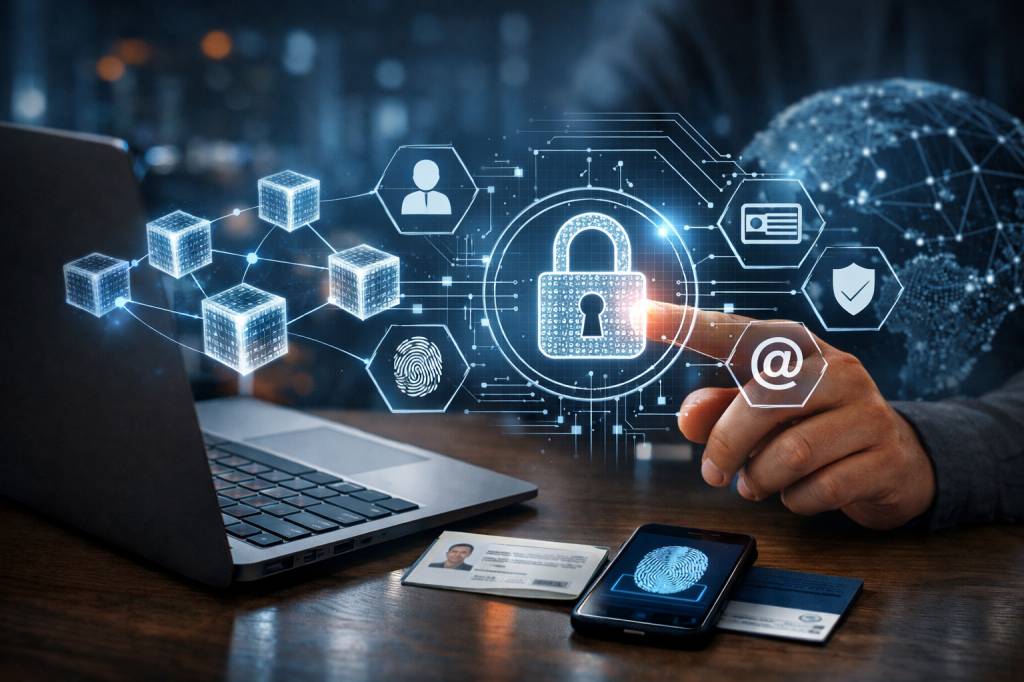
Passwords are broken. Data leaks are routine. And somewhere, your “secure” identity is probably stored in a database that’s already been scraped, hacked or sold. In this context, blockchain isn’t just a buzzword from the crypto world – it’s quietly redesigning how we prove who we are online, and how our data is protected.
But is blockchain really the game changer for digital identity and security, or just another layer of complexity? Let’s unpack what’s actually happening, sans hype.
From centralised identity to self-sovereign identity
Today, most of your digital identity is managed by third parties: Google, Facebook, Apple, your bank, your government. They store, validate and control your data. If they’re compromised, you are too.
Blockchain-based identity turns this model upside down with a concept called self-sovereign identity (SSI): you hold and control your identity data yourself, instead of relying on a central authority.
In practice, this usually looks like:
- A digital wallet (on your phone or hardware device) that stores your identity credentials.
- Credentials issued by trusted entities (state, university, bank, employer), but stored and controlled by you.
- A blockchain that doesn’t store your personal data, but records proofs, cryptographic keys and revocation lists.
This is a subtle but radical shift: your identity is no longer a file in someone else’s server, but a set of verifiable claims you carry with you. The blockchain acts as a trust layer, not a data warehouse.
How blockchain secures digital identity (without storing everything on-chain)
One misconception: “Blockchain identity” does not mean dumping your passport data onto a public ledger forever. That would be a privacy disaster.
In modern architectures, three key elements work together:
- Decentralised Identifiers (DIDs): These are globally unique identifiers tied to cryptographic keys, registered on a blockchain. Think of them as your “anchor” in the system – they prove control without revealing who you are.
- Verifiable Credentials (VCs): These are digital versions of documents like IDs, diplomas or proof of age. They’re signed by an issuer (e.g. a government) and stored in your wallet, not on-chain.
- Blockchain ledger: Used to register DIDs, verify signatures, and check whether a credential has been revoked, without exposing your personal information.
When you share your data with a service, it checks:
- That your credential is valid and signed by a trusted issuer.
- That it hasn’t been revoked (using information referenced on the blockchain).
- That you actually control the relevant keys (via cryptographic proof).
No central database. No password reuse. No massive “identity honey pot” waiting to be hacked.
Zero-knowledge proofs: proving without revealing
Security isn’t just about protecting data; it’s also about not oversharing it in the first place. This is where blockchain-based systems often integrate zero-knowledge proofs (ZKPs).
With ZKPs, you can prove something is true without revealing the underlying data. For example:
- Prove you’re over 18 without sharing your birth date.
- Prove you live in a country without disclosing your full address.
- Prove you have sufficient funds without exposing your account balance.
Combined with a blockchain-backed identity system, this means services can run precise checks with minimal data exposure. Regulatory requirements are met, but your privacy doesn’t get sacrificed as collateral.
Real-world uses: beyond crypto logins
So where is this actually being used, outside of whitepapers and TED talks?
- Government digital IDs Several countries are experimenting with blockchain for national IDs or official credentials. The EU’s framework for the European Digital Identity Wallet includes support for verifiable credentials and decentralised identifiers, and some pilot projects use blockchain under the hood to manage trust and revocation.
- University diplomas and professional certificates Fake degrees are a real problem. Universities and platforms like Coursera are exploring blockchain to issue tamper-proof certificates. Employers can instantly verify authenticity, while candidates keep all their credentials in a single digital wallet.
- Know Your Customer (KYC) in finance Banks repeatedly ask customers for the same documents, storing copies in multiple databases. With a blockchain-based identity, a certified KYC provider could issue a reusable credential. You share a proof, the bank verifies it on-chain, and no one has to pass your passport scan around like a PDF souvenir.
- Healthcare access Medical data is sensitive and fragmented. Some projects are exploring blockchain-backed identities so that patients can control who accesses what, while hospitals and insurers can verify entitlements and records without broad data sharing.
In all these scenarios, the goal is the same: make identity verifiable, portable and secure, without replicating the surveillance and data hoarding of Web2.
Security gains: what blockchain really fixes
Blockchain is not magic, but it does address several chronic weaknesses of traditional identity systems.
- Elimination of centralised identity silos No single provider owns or stores everything. This drastically reduces the impact of a single breach. Attacking one node or service doesn’t grant access to millions of identities.
- Integrity by design Once a record (e.g. a DID or issuer registry) is on the blockchain, it’s extremely difficult to tamper with it without detection. This makes it far harder to forge identities or backdate changes.
- Cryptographic authentication instead of passwords Instead of “something you know” (passwords), blockchain systems rely on “something you control” (private keys). Phishing becomes harder because the underlying authentication mechanism is cryptographic, not based on typing secrets into random forms.
- Fine-grained revocation If a credential needs to be revoked (e.g. your ID expires, or a professional licence is removed), the status can be updated and referenced on-chain. Relying parties can check this without needing direct connection to the issuer’s database.
Put simply: blockchain brings strong, transparent, tamper-evident infrastructure to identity. That doesn’t fix every problem, but it raises the baseline security significantly when implemented correctly.
New attack surface: what could go wrong?
Now the uncomfortable part: blockchain also introduces its own risks. Swapping one set of problems for another is not progress.
- Key management is hard for humans Lose your private keys, lose access to your identity wallet. This is not just a “forgot password” moment; depending on the design, it can lock you out of services or assets. Recovery mechanisms (social recovery, hardware backups, custodial solutions) are essential, but add complexity.
- Device compromise If your phone is infected with malware, an attacker could use your identity wallet as easily as they use your banking app. Blockchain doesn’t magically secure the endpoint device; it only secures the shared infrastructure.
- Irreversibility cuts both ways A transparent, append-only ledger is great for integrity, but terrible for mistakes. A bad configuration, a leaked key or a poorly designed smart contract can cause long-term damage. Careful design around what goes on-chain (and what stays off-chain) is critical.
- Privacy risks on public blockchains Even if you don’t store personal data directly, metadata (timestamps, interactions, patterns) can be analysed. Using public chains for identity requires robust privacy controls, or regulators will (rightly) raise concerns.
Blockchain pushes us to rethink where we place trust. Instead of blindly trusting institutions, we now trust code, cryptography and networks. That’s powerful – but only if those systems are designed, audited and governed responsibly.
Regulation, standards and the identity arms race
Digital identity is not a playground; it sits at the intersection of law, security, human rights and commerce. Unsurprisingly, regulators and standard bodies are very active in this field.
Key movements include:
- W3C standards for DIDs and Verifiable Credentials These technical standards define how decentralised identifiers and credentials should work across platforms. Without them, we’d have a chaos of incompatible solutions.
- EU eIDAS 2.0 and European Digital Identity Wallet The European Union is pushing a framework where citizens can use digital wallets for identity across borders. Blockchain is not mandated, but many pilot implementations use it as the trust layer for credentials.
- Data protection frameworks (GDPR and beyond) A key question: how do you reconcile the “right to be forgotten” with an immutable ledger? The common answer: don’t put personal data on-chain, only references and proofs. But regulators will check that this boundary is respected in real systems, not just in architecture diagrams.
For businesses, this means any blockchain-based identity project must be built with compliance from day one. “We’ll fix privacy later” is how you end up on the front page for all the wrong reasons.
What this changes for everyday users
All this is interesting, but what could it mean in practice for someone logging in, paying, travelling or signing contracts?
- Fewer passwords, more secure logins Instead of creating accounts everywhere, you authenticate with your identity wallet. A bit like “Login with Google”, but without Google sitting in the middle of every transaction.
- Faster onboarding Opening a bank account or signing up for a financial service could become a matter of presenting an already verified KYC credential, not sending documents again and again.
- Portable reputation Your professional history, education or even marketplace reputation could be carried between platforms, without them owning or locking your data.
- Selective sharing Instead of sending a scan of your entire ID to prove one detail, you share only that detail, cryptographically verified. Less oversharing, less exposure.
If this model is implemented with good UX, many users may not even know blockchain is involved – and that’s probably the best sign that the technology has matured.
What this changes for companies and developers
On the other side of the equation, organisations need to rethink how they treat identity.
- From storing data to verifying claims Instead of building massive user databases, services will increasingly request verifiable credentials and keep only what they strictly need. This shifts liability and reduces breach impact.
- Interoperable identity flows With standards like DIDs and VCs, integrations can become more universal. A single verification flow can support multiple wallets and issuers, instead of bespoke connectors for each provider.
- New roles in the ecosystem New players are emerging: credential issuers, wallet providers, verification services, trust registries. Many companies will play at least one of these roles.
For developers, the challenge is to hide the complexity. Key management, blockchain interactions, ZK proofs – all of this must be wrapped in SDKs and flows that feel as simple as today’s OAuth buttons, but radically more secure.
How to evaluate a blockchain identity solution (without falling for the pitch deck)
If you’re a decision-maker or builder, how do you separate serious solutions from marketing slides?
- Check standards support Does the solution implement recognised standards like W3C DIDs and Verifiable Credentials, or is it a closed, proprietary system with “blockchain” as a label?
- Look at what’s actually on-chain Are they storing personal data on the blockchain (red flag), or only identifiers, proofs and revocation data?
- Examine the recovery model What happens if a user loses their device or keys? Is there a clear, secure recovery process, or is the answer essentially “don’t lose it”?
- Check the governance Who controls the network, the smart contracts, the registries? If everything ultimately depends on one company, the “decentralisation” claim is weak.
- Audit and security posture Have the smart contracts, cryptographic protocols and wallet implementations been independently audited? Are the reports public?
A mature solution will be transparent on these points, not evasive.
So, is blockchain the future of digital identity and security?
Blockchain will not erase identity theft, phishing or cybercrime. Attackers adapt fast, and no single technology solves human error or social engineering.
But as a trust layer, it offers something the current patchwork of logins, central databases and static IDs cannot: a globally verifiable, tamper-resistant, user-centric identity infrastructure.
The real transformation is not “put identity on the blockchain”, but “stop treating identity as a static file in someone else’s database”. When individuals carry their credentials, and services verify rather than hoard data, the entire risk distribution changes.
As always in tech, the difference between a revolution and a fiasco will lie in the implementation details: UX, standards, governance, regulation, and honest analysis of trade-offs. If these pieces fall into place, the most secure version of your digital identity might not be stored in a vault at all – it might be something you control in your pocket, anchored to a blockchain you never directly see.
— Lili Moreau