










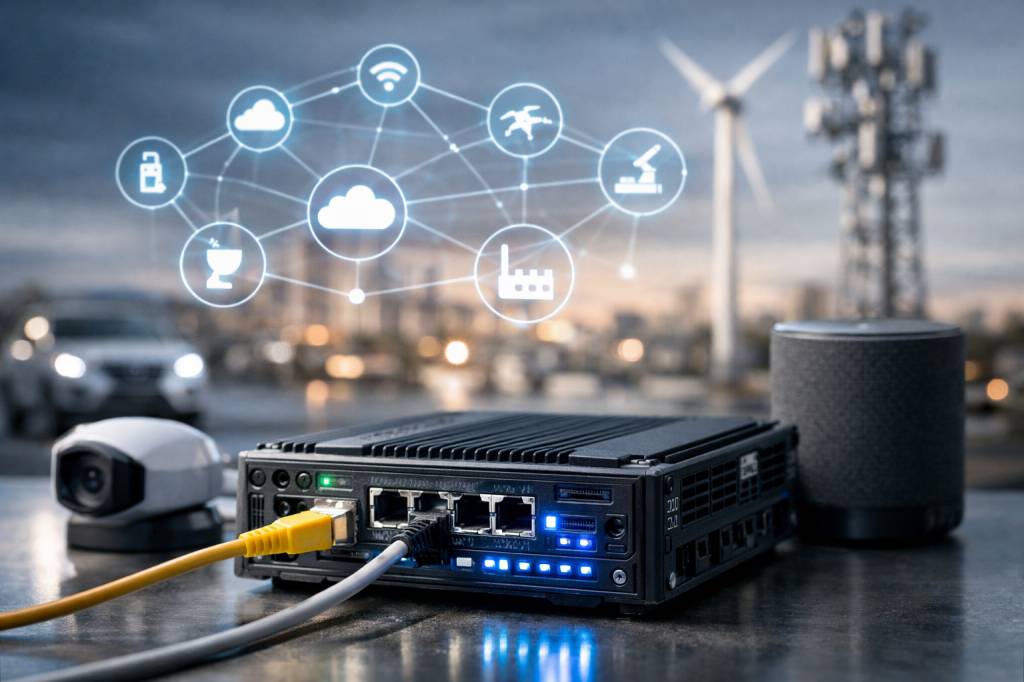
Smart cameras that analyze video in real time. Drones that detect obstacles without a data center in sight. Factory machines that predict failures before they happen. All these “next-gen” IoT devices share the same secret weapon: edge computing.
For years, the story was simple: connect devices, send data to the cloud, run analytics, send a response back. Today, that model is cracking under the weight of billions of sensors, stricter latency needs, and rising bandwidth costs. The answer isn’t “more cloud” — it’s “more intelligence at the edge”.
Let’s unpack how edge computing is quietly reshaping the IoT ecosystem, and what this means for developers, businesses, and anyone building connected products in the real world.
From cloud-centric IoT to edge-native ecosystems
The first wave of IoT was mostly about connectivity: stick a sensor on something, send data to the cloud, look at dashboards. It worked — until it didn’t.
As IoT fleets grew from dozens to thousands (and now millions) of devices, several limits appeared:
- Cloud dependency: if the connection drops, the device is half blind.
- Latency: round trips of 100–300 ms are fine for a dashboard, not for a robot arm.
- Bandwidth costs: streaming raw video or high-frequency telemetry is expensive.
- Energy usage: constant uploads drain batteries and cellular plans.
Edge computing flips the script. Instead of “sensors → cloud → decisions”, the new pattern looks more like “sensors → edge intelligence → cloud (when it’s worth it)”.
The cloud doesn’t disappear; its role shifts. It becomes the brain for training models, coordination, long-term analysis, and fleet management — while the edge handles fast, local, and context-aware decisions.
What exactly is edge computing?
Edge computing is a distributed computing model where data processing happens as close as possible to where data is generated — on the device itself or on a nearby gateway, base station, or local server.
In practice, “the edge” can mean different things depending on the use case:
- On-device edge: a smart thermostat running ML directly on its microcontroller.
- Gateway edge: an industrial gateway aggregating and processing sensor data in a factory.
- Network edge: compute hosted at a 5G base station or ISP PoP (Point of Presence).
- On-prem edge servers: a local server in a hospital or warehouse, running real-time applications.
The common denominator is simple: decisions are made closer to the data source, not in a distant centralized cloud.
Why pure cloud IoT is hitting its limits
You could ask: is edge computing just a buzzword to sell more hardware? Let’s look at the constraints driving this shift.
Latency: If a self-driving car has to ask a data center “Is that a pedestrian?” every time its sensors see something suspicious, it’s game over. Even a 100 ms delay can be unacceptable in scenarios like:
- Robots avoiding collisions on a factory floor
- Machine shutdowns to prevent accidents
- Real-time video analytics for security
Bandwidth: A single 1080p security camera can generate several GB of video data per day. Multiply that by hundreds of cameras and you quickly hit a bandwidth wall. Sending everything to the cloud is both technically and economically unsustainable.
Reliability: Network outages happen — Wi-Fi, 4G/5G, satellites, you name it. A “cloud-only” IoT device becomes useless or even dangerous if it cannot operate safely offline for a while.
Privacy and compliance: Healthcare, industrial, and smart city deployments increasingly need data to stay on-premise or at least pseudonymized before leaving the site. Pushing processing to the edge simplifies compliance and reduces risk.
Edge computing is not about replacing the cloud, but about recognizing that not all computations are equal. Some can wait; some cannot.
How edge computing is powering the next generation of IoT devices
So what actually changes inside an IoT device when edge computing enters the picture? Three shifts stand out: smarter processing, selective data sharing, and autonomy.
On-device intelligence replaces raw data streaming
Instead of streaming everything, next-gen IoT devices run analytics directly on their CPUs, GPUs, TPUs, or even tiny ML accelerators (think ARM Cortex-M, NVIDIA Jetson, Google Edge TPU).
Example: a smart camera doing object detection locally.
- Old model: send the video feed to the cloud, run object detection there, send back alerts.
- New model: run object detection on the camera, send only event metadata (“person detected at 14:03”, “license plate XYZ123”).
The impact is huge:
- ~90–99% less data over the network.
- Near-instant alerts (tens of milliseconds instead of hundreds).
- Less exposure of raw visual data — better for privacy.
This pattern now extends to vibration sensors for predictive maintenance, wearables for health monitoring, drones for mapping, and more.
Selective, compressed, and contextual data to the cloud
When devices become smarter, the cloud stops being a dumping ground for raw telemetry and turns into a strategic repository for:
- Aggregated statistics instead of raw streams.
- Event logs rather than continuous sensor feeds.
- Model feedback (what worked, what didn’t) to improve algorithms.
Think of it as: the edge does the “what now?”, the cloud does the “what next?”. The device acts in the moment, the cloud optimizes over weeks and months.
Autonomous behavior, even offline
With edge computing, IoT devices can operate safely with intermittent or limited connectivity. This is critical in:
- Remote agriculture (fields with poor coverage)
- Maritime and logistics (ships, containers, trucks)
- Industrial plants with strict network segmentation
A sensor node might:
- Detect anomalies in real time
- Trigger local actions (alarms, shutdowns, adjustments)
- Cache data and sync with the cloud when connectivity returns
Instead of being “dumb endpoints”, devices become distributed agents with their own decision logic.
Key architectural patterns for edge-powered IoT
Edge computing is not one single architecture; it’s a spectrum. A few recurring patterns are emerging in real deployments.
Device + gateway model
Typical in factories, energy grids, and buildings:
- Low-power sensors connect via Modbus, CAN, Zigbee, BLE, LoRaWAN, etc.
- A gateway aggregates and normalizes data, runs local analytics, and controls actuators.
- The gateway syncs with a cloud platform for management and reporting.
This allows you to keep constrained devices simple while concentrating complexity in a more capable edge node.
Federated intelligence
In some scenarios, multiple edge devices collaborate without central control. For example:
- Drones sharing mapping data peer-to-peer in an area with no coverage.
- Smart meters coordinating load balancing in a microgrid.
Here, each device has partial knowledge, and coordination happens locally or opportunistically when nodes encounter each other.
Cloud-managed, edge-executed
This is becoming the dominant model for large-scale fleets:
- The cloud pushes models, business rules, and software updates.
- The edge (device or gateway) executes logic in real time.
- Telemetry and performance feedback flow back to refine models.
Think of it as treating the edge like a distributed runtime environment managed from a central control plane.
Real-world use cases where edge computing changes the game
Let’s move from theory to practice. Where is edge computing already making IoT devices dramatically better, not just marginally different?
Smart manufacturing (Industry 4.0)
Factories are full of sensors: vibration, temperature, acoustic, vision… Sending all that to the cloud is both slow and expensive. Edge-powered IoT enables:
- Real-time quality control via camera inspections on the line.
- Predictive maintenance models running at the machine or cell level.
- Local safety interlocks that do not depend on an external network.
Some manufacturers have reported double-digit reductions in unplanned downtime by moving key analytics to the edge.
Retail and smart buildings
Cameras, people counters, environmental sensors, and connected HVAC systems benefit hugely from local intelligence:
- Occupancy-based lighting and heating with on-site processing.
- In-store analytics that never send identifiable faces to the cloud.
- Local caching of control logic to avoid “cloud outage = lights out”.
Edge computing also allows retailers to comply more easily with data protection regulations by processing and anonymizing data as soon as it is captured.
Connected vehicles and mobility
Cars, trucks, and autonomous robots are essentially mobile edge platforms. They combine:
- Onboard perception (cameras, lidar, radar processed locally).
- Path planning and control loops in real time.
- Cloud sync for maps, telemetry, and OTA updates.
Here, latency budgets are often in the single-digit millisecond range. Edge computing is not optional; it’s a core design constraint.
Healthcare and medical devices
From wearables to hospital equipment, edge-powered IoT can monitor patients continuously while protecting sensitive data:
- ECG or SpO₂ analysis done directly on-device or on-prem.
- Only alerts and aggregated trends sent to the cloud.
- Local decision-making for life-critical thresholds, independent of connectivity.
This reduces cloud exposure of raw health data and supports hospital policies that restrict what can leave the premises.
Challenges and trade-offs you can’t ignore
Edge computing is not magic. It simply moves complexity around. Before jumping in, it’s worth being clear about the trade-offs.
Hardware constraints
Running analytics or ML at the edge means more capable hardware, which often means:
- Higher BOM (bill of materials) cost.
- More power consumption (not ideal for battery devices).
- Thermal and mechanical challenges in harsh environments.
Designers must choose carefully: what really needs to run on-device, and what can stay in the cloud?
Software complexity and fragmentation
In the cloud, you control the environment. At the edge, you deal with:
- Different OSes (RTOS, Linux variants, Android, custom firmware).
- Limited resources (RAM, storage, compute).
- Constrained update mechanisms (OTA must be safe and robust).
Tooling is improving (Docker at the edge, Kubernetes variants, specialized IoT OSes), but fragmentation is still a real issue.
Security at massive scale
Edge computing increases the attack surface:
- More devices with more capabilities = more potential entry points.
- Physical access to devices makes tampering easier.
- Local data stores become valuable targets.
This requires strong identity, encryption, secure boot, hardware root of trust, and a disciplined approach to patching and updates.
Operational complexity (DevOps → DevEdgeOps?)
Managing thousands of smart devices in the field is very different from managing servers in a few data centers. You need:
- Fleet management platforms for provisioning, monitoring, and updating devices.
- Observability adapted to intermittent connectivity.
- Rollout strategies that handle failures gracefully (e.g., phased OTA updates).
The organizations that succeed treat edge fleets like critical infrastructure, not “set-and-forget gadgets”.
How developers can start building edge-powered IoT today
You don’t need a massive budget or a dedicated hardware lab to experiment with edge computing. A pragmatic path usually looks like this.
1. Start with a real constraint
Don’t add edge for the buzzword. Identify a concrete problem:
- Latency too high for current use case?
- Cloud costs exploding with data volume?
- Compliance needs forcing you to keep data on-prem?
Let the constraint drive the architecture, not the other way around.
2. Prototype on accessible hardware
Developer-friendly boards and platforms make it simple to build edge prototypes:
- Raspberry Pi or similar SBCs for gateways and local servers.
- ESP32 or ARM-based MCUs for low-power devices.
- Jetson Nano, Coral Dev Board, or similar for edge AI workloads.
Combine that with public clouds that support edge features (e.g., AWS IoT Greengrass, Azure IoT Edge, GCP IoT + Edge TPU) to quickly validate concepts.
3. Push simple logic to the edge first
You don’t need deep learning from day one. Often, simple rules or lightweight models already bring big gains:
- Threshold-based alerts (“if vibration > X for Y seconds, trigger maintenance check”).
- On-device filtering (“send data only if it changes by more than Z%”).
- Basic anomaly detection using moving averages or simple ML models.
Once this pipeline is stable, you can incrementally introduce more advanced ML or computer vision.
4. Design for updates from day one
If your device runs logic at the edge, it needs safe and secure updates. Otherwise, every bug becomes a recall risk. Non-negotiable elements:
- OTA updates with rollback mechanisms.
- Code signing and integrity checks.
- Versioned configurations and models.
Edge devices without a robust update story are ticking time bombs, both technically and from a security perspective.
What’s next: where edge + IoT is heading
Edge computing is still evolving rapidly, but a few trends are already visible for the next 3–5 years.
TinyML everywhere
Machine learning models are being aggressively compressed (quantization, pruning, distillation) to run on microcontrollers with kilobytes of RAM. This allows:
- Audio keyword detection on battery-powered sensors.
- Local anomaly detection on constrained industrial devices.
- Smarter wearables without constant phone/cloud connectivity.
This trend could turn “dumb” sensors into truly intelligent nodes without changing their form factor.
Standardized edge runtimes
Today, running apps at the edge often means bespoke setups. We’re seeing the rise of:
- Containerized workloads for gateways and on-prem servers.
- WebAssembly (Wasm) for secure, lightweight sandboxed execution.
- Common APIs for device management and telemetry.
This should gradually make edge deployments feel more like “normal” cloud-native development, just in more hostile environments.
5G and network slicing as an enabler
5G is often overhyped, but one area where it matters is at the edge:
- Lower and more predictable latency between devices and nearby edge nodes.
- Network slicing to guarantee QoS for critical IoT traffic.
- Integrated MEC (Multi-access Edge Computing) nodes deployed by operators.
In plain English: your IoT device might talk to a “mini-cloud” at the cell tower instead of a faraway region.
More regulation, more local processing
Data protection and AI regulations are tightening globally. Expect more requirements around:
- Keeping identifiable data on-prem or on-device.
- Explainability and auditability of automated decisions.
- Geofencing of where sensitive data can be processed.
Edge computing aligns well with these constraints by default: process sensitive data locally, send only what is necessary and anonymized.
In short: the “dumb sensor + smart cloud” era is fading. The future looks much more like an intelligent mesh, where every layer — device, gateway, network edge, and cloud — plays a specific role.
For anyone building IoT products today, the key question is no longer “Should we use edge computing?” but rather “Which parts of our logic belong at the edge, and why?”. The projects that answer this honestly — with real constraints and clear trade-offs — will be the ones that actually scale, both technically and economically.
Because in the next generation of IoT, the winning devices won’t just be connected. They’ll be decisively, deliberately, and strategically smart at the edge.