


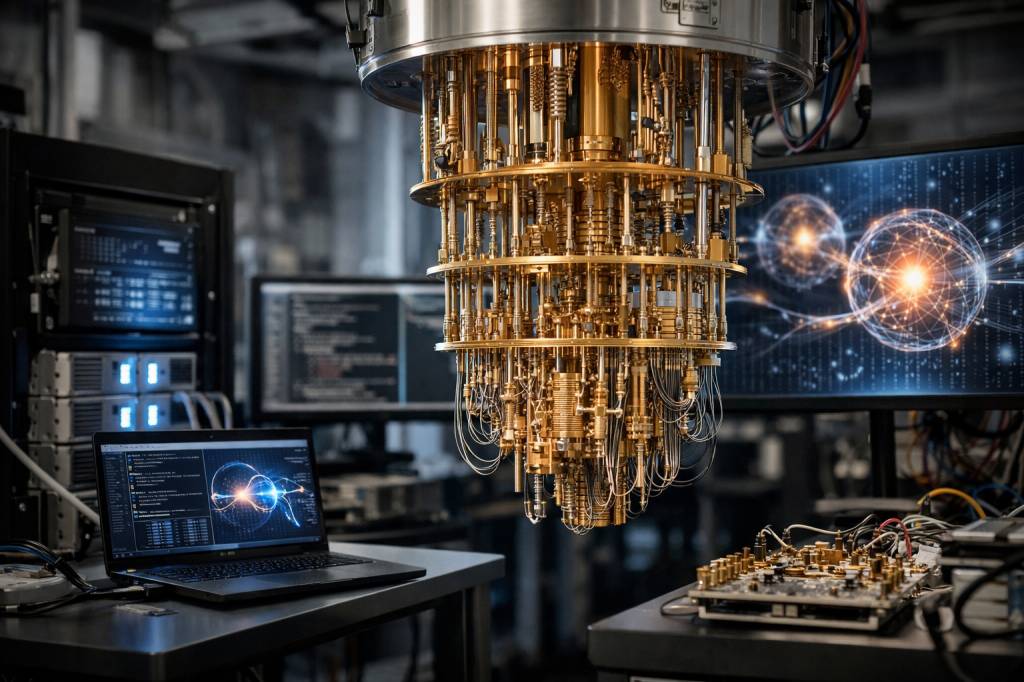
Quantum computing sounds like a buzzword designed to sell sci-fi movies and VC decks. But behind the hype, there’s a real shift underway — one that doesn’t just give us “faster computers”, but fundamentally changes how we think about writing software.
If you’re a developer, architect, product owner, or just tech-curious, it’s time to stop seeing quantum as un “truc de labo” and start viewing it as a new paradigm that will eventually sit next to your IDE, your CI/CD pipeline and your favorite cloud dashboards.
What makes quantum computing so different from classical computing?
Let’s clear something up: quantum computers are not just supercharged versions of classical machines. They don’t replace them, they complement them.
Classical computing is built on bits: 0 or 1. Quantum computing is built on qubits, which can be in a superposition of 0 and 1 at the same time. Add entanglement (qubits that share a linked state) and interference (ways to amplify “good” results and cancel “bad” ones), and suddenly you’re not just iterating through options — you’re exploring huge solution spaces in parallel.
Practically, this changes three core assumptions most developers live with today:
- Determinism: You expect the same input to always give the same output. Many quantum algorithms are inherently probabilistic.
- State: You’re used to being able to read a variable without destroying it. In quantum, measuring a qubit collapses its state.
- Resources: You scale horizontally or vertically. In quantum, you leverage massive parallelism inside the math itself.
Quantum computing isn’t “better Excel”. It’s a different game board.
Where quantum could actually matter for software
Quantum will not make your CRUD app magically cooler. It will not help you ship your React front faster. But it could be a game-changer in a few very specific domains that already push classical hardware to the edge.
Today’s most promising targets:
- Cryptography: Shor’s algorithm can, in theory, break widely used public-key cryptosystems (RSA, ECC) by factoring large numbers efficiently.
- Optimization problems: Logistics, portfolio optimization, scheduling, route planning, supply chain — anywhere you’re juggling huge combinatorial spaces.
- Machine learning: Quantum-enhanced models and kernel methods that accelerate or improve pattern detection on complex data.
- Simulation: Chemistry, materials science, pharma R&D — simulating molecules and reactions at a scale classical systems struggle with.
If your software touches these areas, quantum is not “nice to know”. It’s a strategic risk — or an opportunity.
From algorithms to circuits: a new mental model for developers
Quantum programming forces you to think less in terms of step-by-step instructions and more in terms of transformations on states.
Instead of:
- “First do A, then B, then loop over C.”
You think:
- “Start with an initial state, apply this set of gates (operations) that transform it, then measure what’s left.”
Quantum software is often expressed as circuits: sequences of gates applied to qubits, visualized as horizontal lines with operations laid out over time. It’s closer to designing a signal processing pipeline than writing imperative code.
Concretely, this means:
- No copy-paste state: You can’t clone unknown quantum states arbitrarily (the “no-cloning theorem”). That alone breaks a ton of traditional software patterns.
- Reversibility matters: Quantum operations are reversible. Many quantum algorithms are built as reversible versions of classical logic.
- Measurement is destructive: You only get classical bits out at the end. Measure too early, and you lose your quantum advantage.
If you’re used to thinking in objects, REST endpoints and side-effect-heavy code, this feels alien. If you’re comfortable with functional programming or linear algebra, you’re a few steps ahead.
Meet the quantum toolchain: SDKs, clouds and simulators
Quantum computing isn’t a black box you access through magic APIs. It’s slowly becoming a fairly normal developer ecosystem — just with far stranger hardware at the end of your CI pipeline.
Right now, the main stacks look like this:
- Qiskit (IBM): Python-based, open-source SDK. You write circuits, run them on simulators or IBM’s real quantum hardware via the cloud.
- Azure Quantum (Microsoft): A cloud platform that lets you target different quantum hardware providers, plus tools like Q# and resource estimators.
- Google Cirq: A Python library to build and run quantum circuits, especially tuned for Google’s own devices and research.
- Amazon Braket: AWS’s quantum service that unifies multiple backends (IonQ, Rigetti, etc.) with familiar AWS tooling.
Important detail: most developers won’t have a quantum machine in the office. Access is remote, shared and highly constrained. You’ll often develop and debug on simulators — which are slow and memory-hungry — and only send small, critical jobs to real quantum processors.
So yes, we are heading into a world where your “test” environment might be on your laptop, but your “prod” environment is a noisy chip cooled close to absolute zero in a datacenter you’ll never see.
Why software architecture will need a quantum upgrade
Quantum isn’t going to replace your stack. It will likely plug into it as a specialized accelerator — the same way we use GPUs today for ML workloads.
Imagine your future architecture:
- Your users interact with a web or mobile app.
- Your backend runs on classical cloud infrastructure.
- Certain high-value tasks — route optimization, risk calculation, molecular scoring — are offloaded to a quantum service via an API.
That creates new design constraints:
- Latency: Quantum jobs are queued, limited and not instant. You may need asynchronous patterns or batch processing.
- Cost control: Quantum hardware is expensive. You won’t spam it with every request; you’ll reserve it for very specific, high-ROI calls.
- Hybrid algorithms: Many practical workflows will mix classical and quantum steps — classical pre-processing, quantum core, classical post-processing.
Think of it as rewriting the “hot path” of certain algorithms with quantum subroutines, while 95 % of your system stays happily classical.
Goodbye, current crypto: what developers need to prepare for
If there’s one area where quantum will force almost everyone to update their software, it’s cryptography.
Shor’s algorithm, running on a sufficiently powerful quantum computer, could break RSA and ECC — the backbone of HTTPS, VPNs, digital signatures and more. We don’t know exactly when large enough quantum machines will exist, but regulators and standards bodies are not waiting.
The US NIST has already selected candidates for post-quantum cryptography (PQC), with algorithms designed to resist quantum attacks using classical hardware. That’s the future of secure communication — and it has direct impact on software teams.
What this means for you over the next decade:
- Inventory your crypto: Know where and how you use RSA, ECC, key exchanges, certificates and long-lived secrets.
- Plan for migration: Protocols, libraries, SDKs, hardware tokens — all will need updates to PQC-safe versions.
- Watch the “harvest now, decrypt later” risk: Sensitive data intercepted today could be decrypted later by quantum-capable attackers.
This isn’t just a CIO problem. If your app stores, transmits or signs anything of value, quantum-safe cryptography will land directly in your backlog at some point.
How quantum changes the development workflow
Let’s be concrete. How does quantum computing change the day-to-day life of a software team?
Three big shifts:
- New roles: Expect specialized “quantum algorithm engineers” and “hybrid systems architects” to work alongside classical developers.
- New testing strategies: You can’t fully debug a quantum program by peeking at internal states. You’ll write property-based tests and rely heavily on simulators, statistical checks and resource estimators.
- New performance metrics: Instead of just counting CPU time or memory, you track qubit count, circuit depth, error rates and the number of shots (repetitions) needed for reliable results.
Also, be ready to lose some traditional comforts:
- No printf-style debugging of qubit states.
- No easy step-through of each operation on the real hardware.
- No guarantee that a single run gives you the “right” answer — you look at distributions.
In exchange, you get access to algorithms that could turn certain intractable tasks into solvable ones. It’s a tough but potentially lucrative trade.
Real-world experiments: who’s already playing with quantum software?
We’re not in the era of mass adoption, but we’re well past the pure theory stage. A few examples of what’s already happening:
- Finance: Banks and hedge funds are testing quantum-inspired algorithms for portfolio optimization, risk analysis and fraud detection. Many run on classical hardware today but are designed to later leverage quantum accelerators.
- Logistics: Airlines, shipping companies and car manufacturers are experimenting with quantum approaches to route planning, traffic flow and supply chain optimization.
- Pharma: Drug discovery workflows are being rethought around quantum chemistry simulations — for example, predicting how a molecule binds to a protein more accurately.
Most of these projects are exploratory, small-scale and tightly scoped. But they all share one thing: they require software teams to talk to physicists and mathematicians, and to think beyond their usual toolboxes.
What developers can do today (without a PhD in physics)
You don’t need to become a quantum theorist to stay relevant. But ignoring quantum completely for the next 10 years probably isn’t a great bet either.
Practical steps you can take now:
- Get comfortable with the basics: Superposition, entanglement, gates, circuits, measurement. There are excellent beginner-friendly courses and interactive tools.
- Learn a quantum SDK: Pick Qiskit, Cirq or Azure Quantum and build a toy project. Run something on a real device through the cloud, just to see the workflow.
- Follow cryptography standards: Keep an eye on NIST PQC, IETF discussions and what your favorite cloud/crypto providers are planning.
- Think “hybrid”: When you design systems for optimization, ML or simulation-heavy tasks, start noting where a future quantum accelerator could plug in.
The goal isn’t to rewrite your stack in quantum code. It’s to avoid being caught off guard when your industry’s first real quantum use case moves from lab to production.
A realistic timeline: hype, winters and quiet revolutions
So when does this all hit mainstream software? Not next year. Not fully in five years either.
We’re in what many call the NISQ era: Noisy Intermediate-Scale Quantum. Current machines have tens to a few hundred qubits, with error rates too high for many large-scale algorithms, but good enough to start exploring practical use cases.
Expect the next decade to look something like this (highly simplified):
- Short term (0–5 years): Experimental projects, quantum-inspired algorithms on classical hardware, heavy investment in tooling, education and crypto migration planning.
- Mid term (5–10 years): Early commercial quantum advantage in narrow domains, standardized hybrid patterns, PQC adoption accelerating.
- Longer term (10+ years): If error-corrected, large-scale machines become available, we could see widespread integration in finance, logistics, pharma, energy and beyond.
There will be hype cycles and disappointments on the way — that’s almost guaranteed. But dismissing quantum as “just buzz” is equally risky given the amount of capital, talent and geopolitical focus involved.
Rewriting the rules, one abstraction at a time
For the past decades, software development has mostly evolved inside the same paradigm: classical machines getting faster, more parallel, more distributed — but still grounded in bits, instructions and deterministic execution.
Quantum computing doesn’t simply speed that up. It forces us to ask different questions:
- What problems are we solving that are fundamentally hard for classical machines, but naturally matched to quantum mechanics?
- How do we design APIs, protocols and architectures when part of our stack is inherently probabilistic?
- How do we secure systems when our current crypto assumptions have an expiration date?
The future of software is unlikely to be “all-quantum”. It looks more like a layered ecosystem: classical cores, specialized accelerators (GPUs, TPUs, quantum processors), and smart software abstractions on top that hide the physics from most developers.
Your job, whether you write mobile apps or trading engines, will increasingly be to understand where quantum fits into your problem space — and where it doesn’t. No silver bullets, just new tools with new constraints and possibilities.
If there’s a takeaway, it’s this: you don’t need to panic, pivot your career overnight or start writing everything in Q#. But you probably do need to upgrade your mental model of what “computing” means. Because somewhere, in a freezer-sized box full of qubits, the rules of software are already being quietly rewritten.
And when those rules hit production, it won’t be science fiction anymore. It will just be another ticket in your backlog.