


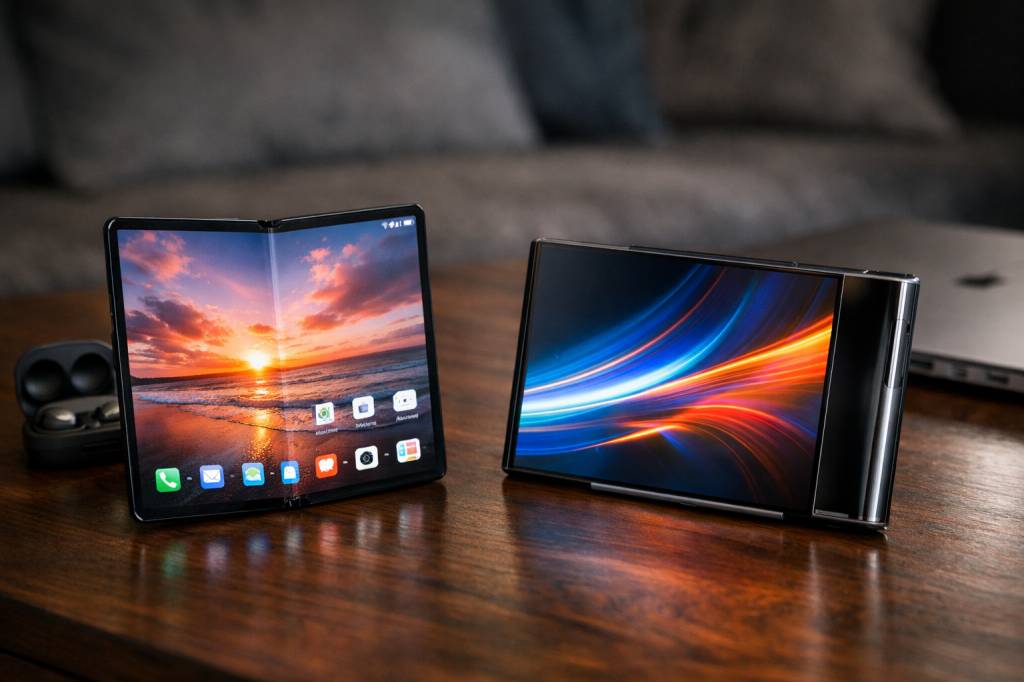
Why are we obsessed with foldable and rollable screens?
Smartphones have hit a plateau. Processors are faster, cameras are sharper, batteries last a bit longer… but the basic slab of glass hasn’t changed in over a decade. Foldable and rollable screens are the industry’s attempt to break that deadlock.
On paper, the promise is seductive:
- a small device in your pocket that unfolds into a tablet,
- a screen that expands on demand for work, gaming or media,
- a new design playground for hardware that finally looks “future tech” again.
But beyond the flashy marketing and sci‑fi vibes, what do these devices really bring? And are they ready to replace your current phone or laptop? Let’s open them up — metaphorically — and see what’s happening inside.
Inside a foldable phone: what actually bends?
A foldable smartphone is essentially three key elements forced to do something they were never meant to do: bend.
- The OLED display – Unlike LCD, OLED does not need a rigid glass backlight. The pixels sit on a flexible plastic substrate (often polyimide). This is what allows the screen to curve or fold.
- The cover layer – Early models used plastic on top (scratch-prone). Newer ones mix ultra-thin glass (UTG) with plastic coatings to combine rigidity and flexibility… with mixed success.
- The hinge mechanism – The real engineering headache. It has to:
- survive hundreds of thousands of folds,
- avoid stressing the screen too much,
- keep dust and debris out.
Most brands now claim between 200,000 and 400,000 folds before failure. That’s roughly 5 to 10 years of daily use at 50 folds per day. In real life, failures often happen earlier — not because of the hinge itself, but because dust or micro-cracks find their way into the display layers.
And the famous crease? Today, it’s not a “bug”, it’s a structural consequence. You are literally forcing stacked layers to bend around a tight radius. The best current hinges try to fold the screen in a gentle curve instead of a hard angle, which makes the crease less visible, but not invisible.
Foldable formats: clamshells vs book-style
Not all foldables target the same usage. Two main formats have clearly emerged.
- Clamshell foldables (vertical fold)
Think flip phones reincarnated: a standard-size smartphone that folds in half to become pocket-friendly.
Pros: compact, lighter, fun, more affordable than book-style foldables.
Who it’s for: users who want something smaller in the pocket, with style as a bonus. - Book-style foldables (horizontal fold)
These open like a book to reveal a near-tablet inside.
Pros: big inner display for multitasking, reading, drawing, gaming, travel and media.
Who it’s for: power users, professionals on the go, digital nomads who want to replace tablet + phone.
In both cases, you’re paying a premium for flexibility — literally — in form factor and usage. The question is: does that flexibility translate into real productivity or comfort, or is it mostly wow effect?
Rollable screens: what changes compared to foldables?
Rollable devices push the idea further. Instead of folding, the screen rolls or extends from one side of the device. Think of a phone that slides out to become a mini-tablet, or a TV that disappears into its base when not in use.
Technically, rollables rely on the same base technology as foldables: flexible OLED on a plastic substrate. The difference is mechanical:
- The display is stored rolled up inside the chassis.
- A motorized (or manual) mechanism deploys it horizontally or vertically.
- The bending radius is more constant and gentle than a fold, which can theoretically reduce stress points.
On paper, advantages are obvious:
- No visible crease in the middle.
- A more “continuous” screen experience (no split, no hinge gap).
- Fewer compromises on thickness when the device is closed.
But for now, rollables are mainly prototypes and demos. The issues are not minor:
- More moving parts and motors = more failure points.
- Dust management becomes even more critical inside the chassis.
- Durability in real life (pockets, drops, pressure) is largely untested.
Foldables are already commercially viable. Rollables are still in their experimental phase. The gap between “cool concept video” and “device you can safely keep for three years” is huge.
Who’s leading the foldable & rollable race?
The market is moving fast, but a few players clearly stand out.
- Samsung
The current benchmark in foldables, especially on global availability and software support. The Galaxy Z Fold and Z Flip lines have gone through multiple generations, each refining durability, crease visibility and camera modules.
Samsung is also experimenting with rollable and tri-fold concepts, but these are not mainstream yet. - Huawei, Oppo, Honor, Xiaomi
In China, competition is aggressive. Devices like the Honor Magic V series or Oppo’s prototypes show very high levels of engineering — slim form factors, advanced hinges, larger internal screens.
The catch? Limited or fragmented availability worldwide, plus software restrictions on some brands due to US sanctions. - Motorola
Playing the nostalgia card with the modern Razr. Strong focus on clamshell designs and lifestyle marketing, with reasonable pricing and a push toward more accessible foldables. - LG (for rollables, indirectly)
LG exited the smartphone market, but left behind serious work on rollable TVs and a nearly-ready rollable phone prototype. Their display division is now a key supplier for others aiming to launch rollable products.
Under the hood, a handful of display manufacturers (Samsung Display, BOE, LG Display) are actually providing the flexible panels. The “innovation” you see on stage is often the visible tip of a supply-chain iceberg that is slowly standardizing the tech.
Everyday life: what do foldables actually change?
A device is only as good as the habits it improves. Here’s where foldables can actually shift your day-to-day digital life.
- Productivity on the go
On a book-style foldable, splitting the screen into two or three apps genuinely helps:- email + document side by side,
- video call + notes,
- browser + code editor or terminal.
You still won’t replace a 15-inch laptop, but for trains, planes, cafés, it’s a serious upgrade from a classic 6-inch display.
- Media and reading
Comics, PDFs, e-books, web articles, YouTube, Netflix: everything benefits from extra screen real estate. The difference is especially noticeable for content you don’t want to constantly zoom and pan. - Photography and video
Foldables enable some clever use cases:- clamshells doubling as their own tripod for time-lapses or group photos,
- rear camera previews on the outer display so your subject sees themselves,
- split-screen video calls with reference material below.
- Digital minimalism… or the opposite
Some users manage to replace phone + tablet with one foldable, reducing the number of devices in their bag. Others fall into “screen sprawl” — more space equals more windows, more notifications, more distraction.
The device doesn’t decide, your habits do.
On the downside, there are still recurring pain points:
- Weight and thickness – Foldables are improving, but they’re still heavier and thicker than standard flagships.
- Battery life – Larger screens draw more power. Vendors compensate with bigger batteries and software optimization, but if you use the inner display heavily, expect to charge more often.
- Fragility anxiety – Even if the device is engineered to survive, many users never quite stop worrying about dust, sand, or that one bad drop.
The real cost: not just the price tag
Foldables tend to sit at the very top of the price range. However, “price” is only part of the equation. The total cost of ownership includes:
- Repairability
Screens, hinges and inner components are more complex and more expensive to replace. A cracked foldable display can cost as much as a mid-range smartphone to fix. - Resale value
The second-hand market for foldables is still young. Demand exists, but many buyers are cautious about hinge wear and screen history. - Software support
Foldables rely heavily on good software adaptation: app continuity between outer and inner screens, multitasking tools, gesture navigation.
Brands that push frequent updates and get developers on board will age better. Samsung currently leads this aspect, but others are catching up.
Does the added flexibility justify a premium of several hundred euros over a regular flagship? For some usage profiles, yes. For most, not yet.
Are rollable devices the better idea in the long run?
Many engineers quietly think rollables are a more elegant solution than foldables. One continuous screen, no central crease, no need to split UI logic between “outer” and “inner” modes. Future rollable phones, tablets, monitors or even laptops could adapt their screen size to the task in real time.
Imagine:
- a phone that expands from 6.3″ to 8.5″ when you edit a document,
- a monitor that widens during a video edit, then shrinks in coding mode,
- a wearable display that rolls out only when needed.
But every generation of hardware has to survive the “jean pocket test” and the “café table test” before going mainstream. Until rollables prove they can take dust, pressure and occasional clumsiness, manufacturers will be cautious. The first commercial wave will likely target enthusiasts and professionals willing to pay — and accept risk — to be early.
Should you buy a foldable or wait for rollables?
If you’re hesitating between a classic flagship, a foldable, or waiting for a rollable, a few simple questions help refine the choice.
- Do you actually multitask on your phone today?
If your typical use is messaging, social media, music, some photos and casual browsing, the value of a book-style foldable is limited.
If you already juggle between email, docs, Slack, Figma, code, dashboards… the extra space can genuinely transform how you use your phone. - Are you replacing a tablet?
If you often carry a tablet for reading or fieldwork, a foldable might reduce your gear. If your tablet is mostly for couch Netflix, your current setup is probably fine. - How much do you care about ruggedness?
If you drop your phone regularly, work in dusty or outdoor environments, or often toss it in a bag with keys and tools, a tough classic phone with a good case is still the rational option. Foldables remain more sensitive. - Are you okay being a “beta tester” for hardware?
Even after several generations, foldables are not as mature as standard phones. You’re paying to live a bit in the future — with the occasional glitch or constraint that comes with it.
As for rollables, if you’re waiting for them to be mainstream, you’ll wait at least a couple more years. Expect first models to be expensive, limited in volume and very much “early adopter” hardware.
What this shift means for the future of our devices
Foldable and rollable screens are not a fad in the sense of 3D TVs or curved phones that never really justified their existence. They solve a real problem: how to carry large screens without carrying large devices.
Beyond smartphones, the ripple effect will be interesting to watch:
- Laptops – Fully foldable or rollable laptops could blur the line between notebook and external monitor. One device, multiple form factors depending on task.
- Wearables – Bracelets that become screens, clothes with embedded displays, modular accessories that roll out when needed.
- Public displays and retail – Rollable signage and dynamic surfaces that can adapt shape and size to space constraints.
For now, if you’re curious but cautious, the most pragmatic approach is simple:
- Test a foldable in-store. Open it, close it, look at the crease from different angles.
- Check how your favorite apps behave: do they use the whole screen or just sit centered with big black borders?
- Read real-world reviews after 6–12 months of use, not just launch-day impressions.
- Compare the price to a standard flagship and a tablet combo. Sometimes, two solid devices still beat one futuristic one.
The world of foldable and rollable screens is exciting precisely because it’s not finished. We’re watching hardware design being re-invented in real time, with all the trial, error and iteration that implies. If you like living on that edge, these devices are already worth exploring. If you prefer tech that quietly gets out of your way and just works, the classic slab of glass still has good years ahead.
As always in digital innovation, the right question is less “Is this the future?” and more “Is this my future right now?” The answer will depend less on marketing promises, and more on how you actually live, work and play with your screens.