


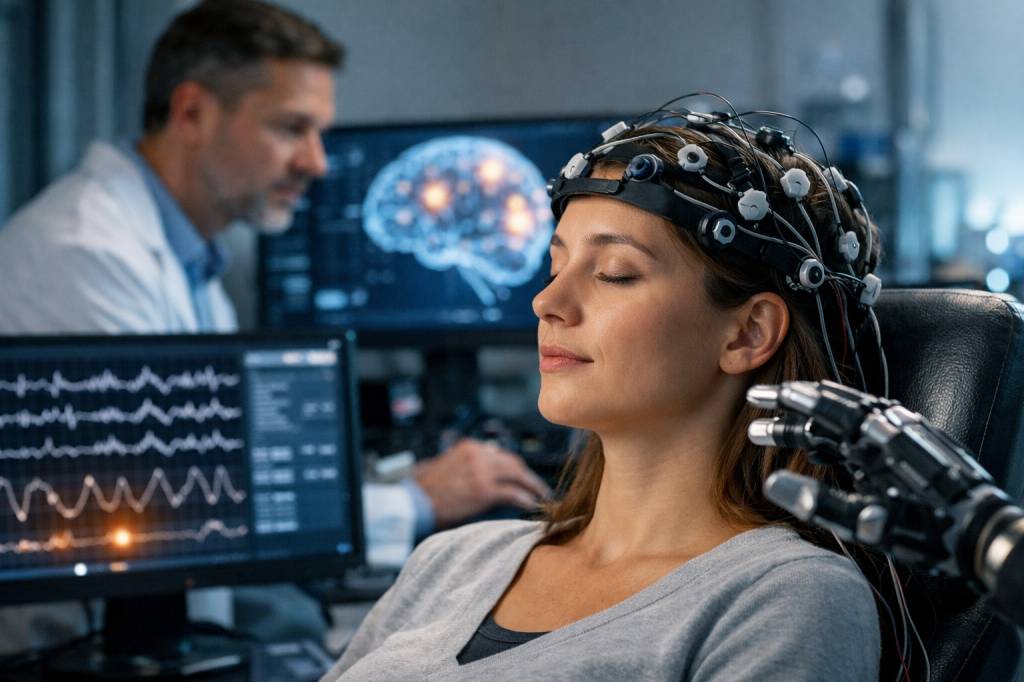
Until recently, “reading someone’s mind” belonged to science fiction and bad magic shows. Today, neurotechnology is turning that metaphor into a technical roadmap. From brain-computer interfaces (BCI) to AI-powered brain scans, we are learning to decode what’s happening in the brain in real time.
Fascinating? Yes. Powerful? Immensely. Dangerous? Potentially.
When technology approaches the last human frontier — our inner thoughts, emotions, intentions — the question is no longer “Can we?” but “On what terms do we allow this?”
What exactly is “neurotechnology” today?
Let’s clear the jargon. Neurotechnology covers all tools that interact directly with the nervous system to measure, stimulate or modify brain activity. In practice, that includes:
- Non-invasive recording devices: EEG headsets, caps, fNIRS devices, advanced fMRI scanners.
- Invasive brain implants: like Neuralink, synchron, or deep brain stimulation (DBS) devices used for Parkinson’s disease.
- Neurostimulation tools: transcranial magnetic stimulation (TMS), tDCS headsets (sometimes sold to “boost focus”).
- AI models for brain decoding: algorithms trained to map patterns of neural activity to images, words, music or intentions.
Most current systems don’t “read thoughts” in the Hollywood sense. They decode:
- Which word you are hearing or trying to say.
- Which image you are looking at.
- Whether you’re focused or distracted.
- Basic emotional states (stress, excitement, boredom).
That might sound limited, but it’s enough to open both life-changing opportunities and ethically sensitive scenarios.
From medical miracle to everyday interface
The most compelling applications are medical and assistive.
In 2023–2024, several labs and companies demonstrated speech decoding from brain signals in paralyzed patients. Using implanted electrodes plus AI models, systems can reconstruct sentences the person is trying to say, with outputs displayed as text or even a synthetic voice. We’re talking about people who went from a few words per minute with eye trackers to 60+ words per minute via neural decoding.
Other teams use EEG or implants to help patients control robotic arms or cursors, write emails, or walk again with exoskeletons guided by brain activity. In those contexts, “mind reading” isn’t a scary concept — it’s a prosthetic for communication.
But neurotech is not staying in the hospital.
Startups and big tech players are exploring:
- Brain-controlled wearables: earbuds or headbands that sense attention, fatigue, or emotional responses.
- Productivity tools: dashboards that show your “focus score” throughout the workday.
- Gaming and AR/VR: BCIs for “thinking” actions instead of pressing buttons.
- Mental health tracking: continuous monitoring of stress or mood from neural data.
As the hardware gets cheaper and less obtrusive (think: sensors hidden in headphones or AR glasses), the jump from therapeutic use to mainstream consumer use becomes a matter of product design and marketing.
And that’s where ethics hit hard.
What does it really mean to “read the human mind”?
For now, no device can read every thought in your head like a streaming transcript.
But several research results should make you pause:
- Using fMRI + AI, teams at the University of Texas at Austin built “semantic decoders” that can reconstruct a rough description of what someone is hearing, imagining, or watching — without exact words, but with surprisingly accurate meaning.
- Other labs used neural data to reconstruct rough images of faces or scenes a person was looking at.
- Some EEG-based systems can predict with good probability which option you’re going to choose a few seconds before you consciously press a button.
We are far from “reading your deepest secrets”, but we can already infer:
- What broad category of thing you’re seeing or thinking about.
- How you emotionally react to a stimulus (ad, video, song).
- Whether something is familiar or not (useful, for example, in lie detection attempts).
Ethically, the crucial point is not perfection. It’s direction. Today’s 60% accuracy system is tomorrow’s 90% after another decade of data, sensors and compute. Waiting until the technology is “too accurate” before reacting would be a textbook case of being late.
Neurodata: the new ultra-personal data
We already fight over data from our browsers, phones, and wearables. Neurodata adds a new layer: it is not just about what we do, but how our brain responds when we do it.
From an ethical standpoint, neurodata is:
- Deeply intimate: it reflects cognition, attention, emotions, maybe one day preferences and beliefs.
- Hard to anonymize: brain patterns can be as unique as fingerprints.
- Persistent: once collected and modeled, a brain profile may remain useful for years.
Now combine this with classic data practices: targeted advertising, behavior prediction, insurance risk modeling, employee monitoring. Imagine a marketing platform whose algorithm knows—not by guess, but by your neural response—exactly which content keeps you engaged, or which political message triggers fear or trust in you.
This isn’t theoretical speculation. Neuromarketing already exists, using EEG and eye-tracking to test ads and packaging. For now it’s limited and expensive, but costs drop fast in tech. At scale, a brain-data-driven attention industry would make today’s cookie banners look almost quaint.
Consent: can you really opt in to having your brain decoded?
Regulators love the word “consent”. Click “I agree”, problem solved. With neurotech, this approach starts to crack.
To give meaningful consent, you must understand:
- What is being measured (raw signals vs. decoded thoughts).
- What can be inferred today — and reasonably tomorrow.
- Who has access to which level of data (device, app, cloud, third parties).
- What happens if your data is reused for new models later.
The reality: most users will never read a 20-page privacy policy on “neural feature extraction pipelines”. If your next pair of AR glasses ships with “optional cognitive optimization features”, how many people will grasp that their brain responses might feed centralized AI models?
This is why several ethicists argue that we need something stronger than regular consent: special “neurorights”.
Neurorights: a bill of rights for your brain?
Some countries are moving faster than others. Chile, for instance, amended its constitution to protect “mental privacy” and “psychological continuity” in 2021, becoming a pioneer in neurorights legislation.
The idea behind neurorights is to create explicit protections such as:
- Right to mental privacy: no entity can access, collect, or process your brain data without strict justification and protection.
- Right to cognitive liberty: freedom to decide whether to use neurotechnology or not, and how.
- Right to mental integrity: protection against manipulation or harmful alteration of brain activity.
- Right to psychological continuity: protection of your sense of identity against deep tech-driven alterations.
In Europe, brain data would already fall under “sensitive data” within GDPR, but GDPR wasn’t drafted with consumer-grade neural decoding in mind. The EU AI Act covers high-risk AI systems, including some health-related technologies, but again: many future neurotech tools will be marketed as “wellness” or “productivity”, skating around strict medical rules.
In other words: the regulatory net is there, but with wide meshes.
Workplace, education, insurance: the quiet frontlines
Let’s leave the lab and step into more ordinary spaces.
At work, imagine companies offering “focus-boosting” headsets that also send anonymized concentration metrics to HR. Or safety-critical jobs (pilots, drivers, surgeons) where fatigue prediction from neural data becomes mandatory.
The risk? A two-speed workplace:
- Those who agree to neural monitoring and may get better evaluations or promotions.
- Those who refuse and are quietly sidelined as “less committed”.
Even “voluntary” monitoring quickly stops being truly voluntary when your career depends on it.
In education, some pilots already use EEG headbands to track student engagement during lessons. On paper, it sounds like a teacher’s dream. In practice, it raises questions:
- Are kids (and parents) in a position to say no?
- What happens to that data over years of schooling?
- Will children be profiled early as “low attention” or “high potential” based on noisy neural metrics?
In insurance and finance, mental health and cognitive decline are major cost drivers. A future where insurers quietly factor your “neural risk score” into pricing is not that far-fetched if safeguards are weak.
These domains won’t grab headlines like a brain implant startup, but they will define how neurotech touches everyday life.
Manipulating the mind: from nudging to full-on hacking?
Reading is one side of the coin. Writing is the other.
We already use technologies that modulate brain activity: antidepressants, DBS for Parkinson’s, TMS for depression or obsessive-compulsive disorder. What changes with AI and digital neurotech is the precision, personalization, and automation of these interventions.
In the near term, expect systems that:
- Detect your emotional state in real time.
- Adapt content or stimulation to optimize engagement, calm you down, or keep you “in the zone”.
- Use closed-loop feedback: the system acts on your brain, measures the response, adjusts, and repeats.
In a therapeutic context, that can stabilize mood, reduce tremors, or prevent seizures. In an advertising or political context, it’s something else: highly optimized persuasion tuned to your neural vulnerabilities.
Are we ready to let commercial actors experiment at that level with our brains? On which terms? With which oversight? Those questions are not academic — they’re policy design questions for the next decade.
What should responsible neurotechnology look like?
If we don’t want a blanket ban (and we shouldn’t — the medical benefits are real), we need a playbook.
Several principles emerge across ethics reports and early legislation:
- Purpose limitation: neurotech used for health or accessibility should not be repurposed for advertising, surveillance, or profiling.
- Data minimization: devices should keep processing local where possible, avoid raw-brain-data uploads, and store only what’s strictly necessary.
- Layered consent: clear, simple explanations of what’s recorded and decoded, with granular options (you may accept basic attention tracking but refuse emotional profiling).
- Strict bans on certain uses: for example, neurotech in criminal interrogation, mandatory brain monitoring at work, or non-consensual lie detection.
- Right to disconnect: the ability to turn off or remove devices without penalty — and without hidden background collection.
On the technical side, developers should integrate ethics from the design stage, not as an afterthought tacked on for PR. That means:
- Privacy-by-design architectures.
- On-device AI when possible.
- Robust security for both firmware and data pipelines.
- Independent audits of high-risk systems.
Will this slow innovation? A bit, probably. But the alternative is worse: a public backlash that shuts down entire lines of research after the first major scandal.
As an individual, what can you actually do?
You won’t single-handedly rewrite international law, but you’re not powerless either. A few pragmatic moves:
- Be picky with “brain tech” gadgets: meditation headbands, “focus” earbuds, neurofeedback apps — check what they store and where. If the privacy policy is vague, walk away.
- Separate wellness from medicine: tools that legitimately treat a diagnosed condition should meet medical standards. Be skeptical of lifestyle devices using medical rhetoric without medical oversight.
- Resist hidden normalization: if your school or employer offers “optional” neuro-monitoring, ask hard questions. Optional can quickly morph into expected.
- Support serious regulation: when public consultations open on AI or digital health, adding an informed comment about neurodata is more useful than a thousand tweets.
Ethics is not just philosophers at conferences; it’s also consumers who refuse to trade mental privacy for a slightly smoother UX.
Why this debate cannot wait
Neurotechnology won’t explode into existence one day in a spectacular reveal. It will seep in quietly: a feature in your VR headset, a “premium focus mode” in productivity software, a brain-sensing option in your sports earbuds.
Each step will look small. Harmless. “Just a bit more data.” But over ten or fifteen years, these micro-choices add up to a society where reading patterns of human thought is technically and commercially routine.
We’ve already seen what happens when we treat digital infrastructure as neutral until it’s too late: social media, recommender systems, mass data collection, algorithmic bias. Neurotechnology gives us a second chance to not sleepwalk into the future.
The core question is simple, even if the details are complex: Who gets access to the human mind, on what terms, and with which safeguards?
Answering that now — with clear rights, robust norms, and technical guardrails — is the best way to ensure that the next generation of brain-computer interfaces empowers human autonomy instead of eroding it.
As always, the technology will keep advancing. The real test is whether our ethical and legal imagination can keep up.
— Lili Moreau, for Crazy Loop