


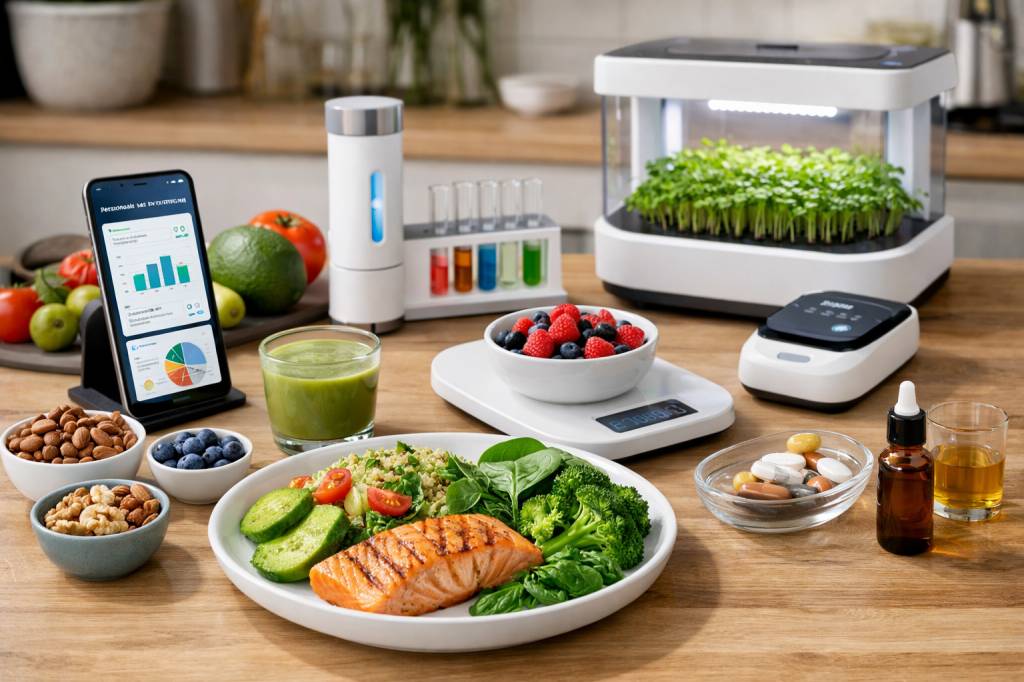
What if your fridge knew more about your metabolism than your doctor? And what if your lunch was optimized not just for “low carbs” or “high protein”, but for your microbiome, sleep patterns, stress level, and training schedule?
That’s the promise—sometimes uncomfortably hyped—of personalized nutrition and food tech. Between DNA tests, continuous glucose monitoring, smart kitchen devices and AI diet apps, the food sector is quietly becoming one of the most data-driven parts of our daily lives.
The question is: how much of this is real value, and how much is just expensive wellness marketing with better UX?
From “eat healthy” to “eat for your data profile”
For decades, nutrition advice looked like this: one-size-fits-all guidelines, pyramids, “5 fruits and veggies a day”, vaguely guilty glances at the dessert menu. Personalized recommendations were mostly “ask your doctor” or “listen to your body”.
Today, the equation is changing. Several factors are converging:
-
Cheap sensors: glucose monitors, smart scales, wearables tracking heart rate variability, sleep, steps, even temperature.
-
Accessible genomics: DNA tests for a few dozen euros, microbiome analysis in a box shipped to your home.
-
AI everywhere: recommendation engines that chew through your biometrics, habits, and food logs to suggest “the perfect meal” for you.
-
Food industry under pressure: ultra-processed foods being questioned, regulatory scrutiny increasing, and consumers asking for transparency and health benefits.
The result: a shift from generic advice (“avoid sugar”) to highly specific outputs (“this particular cereal spikes your blood sugar at 9 a.m., but this other one doesn’t”).
We’re not fully there yet, but several technologies are laying the foundation.
The tools behind personalized nutrition
If you strip away the marketing, personalized nutrition largely rests on four pillars: data collection, individual profiling, recommendation engines, and feedback loops.
Data collection: your body as a live dashboard
Today’s food tech doesn’t just care what you eat—it cares how your body reacts to it.
-
Continuous Glucose Monitors (CGM)
Originally designed for diabetics, CGMs are now used by athletes, biohackers and executives who want to optimize energy and avoid “sugar crashes”. Devices like Abbott’s Libre or Dexcom send real-time glucose data to a smartphone. Paired with apps, they can show—sometimes brutally—what that “healthy” smoothie really does to your blood sugar. -
Wearables & smart scales
Smartwatches and rings (Garmin, Apple Watch, Oura, Whoop) add contextual layers: sleep quality, stress, heart rate variability, activity level. Smart scales add body composition, estimated metabolic age, and sometimes cardiovascular indicators. -
Food logging and image recognition
The classic “food diary” is becoming semi-automated. Several apps now use photo recognition to identify your plate and estimate macros and calories. Accuracy is not perfect, but good enough to feed machine learning models at scale. -
Microbiome and DNA tests
Startups like Zoe, DayTwo or Viome analyze your microbiome, while others focus on nutrigenomics (how your genes influence your response to nutrients). These tests promise to explain why your friend loses weight on a high-carb diet and you gain.
Individually, each data stream is limited. Combined, they create a pretty intimate portrait of how food interacts with your metabolism.
From raw data to “what should I eat?”
Data is only useful if it leads to choices. And that’s where AI comes in.
The typical pipeline looks like this:
-
1. Baseline measurement: a few days or weeks of tracking without changing anything. The system observes your normal patterns.
-
2. Response modeling: how does your body react to specific foods, meal timings, or combinations? Think “oatmeal + coffee at 8:00 a.m. vs. 10:00 a.m. with a walk afterwards”.
-
3. Risk & goal profiling: are you trying to manage pre-diabetes, optimize sports performance, improve sleep, or lose weight? The focus of recommendations changes.
-
4. Real-time or near-real-time nudges: notifications like “you slept poorly, avoid heavy carbs this morning” or “your glucose is stable, now is a good time for that pasta dish.”
To do this at scale, platforms rely on:
-
Machine learning models trained on thousands (sometimes millions) of meals, reactions, and user profiles.
-
Pattern detection: clusters of users with similar responses to certain foods.
-
Reinforcement learning: systems that test small adjustments, measure impact, and refine the next recommendation.
In other words: your plate becomes a live A/B test.
Smart kitchens and “food as a service”
Personalization doesn’t stop at the app. It’s moving into kitchens, supermarkets and delivery services.
-
Smart fridges and inventory tracking
Connected fridges can detect what’s inside (via cameras, barcodes or RFID) and suggest recipes based on your goals and constraints. In theory, they can cross-reference your calendar, training schedule and biometrics. In practice, adoption is still low and the UX often clunky—but the direction is clear. -
Personalized meal kits and subscriptions
Meal kit services are evolving from “choose your recipes” to “get automatically generated menus tailored to your biomarkers and targets”. Imagine a box that changes its contents each week based on your latest blood and glucose data. -
Smart cooking devices
Air fryers, multicookers and ovens are getting connected, pre-programmed for “heart healthy”, “low glycemic” or “high-protein” presets. The next step: devices that adjust in real time based on sensors (for example, oil temperature to minimize harmful compounds). -
Food printers and personalized formulations
3D food printing is still niche, but it points towards ultra-personalized textures, shapes and nutrient compositions—particularly relevant for elderly people, hospitals or elite athletes.
The endgame many startups describe is simple: food as an on-demand service, tuned to your data profile, delivered or auto-cooked with minimal friction.
What actually works (and what’s mostly hype)
Let’s step back from the buzzwords and zoom in on what already shows concrete benefits.
-
Continuous glucose monitoring for non-diabetics
Studies increasingly show high variability in how individuals respond to the same food. Two people can eat the same banana and have totally different glucose curves. CGMs help identify these personal responses and reduce large spikes—linked to fatigue, cravings and long-term metabolic risk.
Is it a magic weight-loss solution? No. But for people at risk of metabolic issues or with unstable energy, it’s a valuable feedback tool—provided the data is interpreted properly. -
Behavioral nudges beat rigid “diets”
Apps that combine small, contextual suggestions (“add protein to this snack”, “walk 10 minutes after this meal”, “stop eating 2 hours before sleep”) often perform better than hard restrictions. Micro-adjustments, consistently applied, are more realistic than perfection. -
Microbiome science: promising, but not fully mature
We know that gut bacteria influence digestion, inflammation, even mood. We also know that everyone’s microbiome is unique. However, the science is still evolving. Some recommendations are solid (diverse fibers, less ultra-processed food), but hyper-specific claims like “this probiotic cocktail will fix your metabolism” deserve a healthy dose of skepticism. -
DNA-based diets: interesting orientation, not destiny
Your genes may indicate a predisposition (e.g., slower caffeine metabolism, lactose intolerance risk, lipid handling). But they don’t override lifestyle. For most people, energy, sleep, stress and activity will still weigh more than a single gene variant.
In short: useful tools exist, but “AI-designed perfect diet” remains more marketing narrative than scientific reality.
The risks: from optimization to obsession
When food becomes fully quantified, a few issues emerge.
-
Data overload and anxiety
Real-time glucose, step counts, calories, macros, microbiome scores, sleep stages—at some point, the experience stops being empowering and starts being stressful. Not everyone wants their breakfast judged by five dashboards. -
Over-promising and pseudo-science
The wellness industry has a history of stretching scientific findings. “Evidence-informed” quickly becomes “miracle solution” in marketing copy. This is especially true for DNA-based diets and microbiome interpretations. Always ask: what’s been tested in controlled studies, and what’s just correlative data on a small cohort? -
Privacy and monetization of your biology
Your food logs are one thing. Your genomic data and microbiome profile are another. Who owns these datasets? How are they anonymized, and how long are they stored? Could insurers or employers be tempted to use them one day? These questions are not theoretical—they’re already surfacing in other health-tech domains. -
Socio-economic gap
Personalized nutrition programs, tests and smart devices aren’t cheap. There’s a real risk of creating a “health privilege elite” with tailored diets and early disease detection, while others struggle with access to basic fresh food.
Personalization can be powerful—if it doesn’t become another layer of inequality or digital pressure.
Where this is heading in the next 5–10 years
Looking ahead, several trends seem likely rather than speculative.
-
From episodic check-ups to continuous metabolic monitoring
Instead of yearly blood tests, we’ll see more continuous or frequent micromonitoring: non-invasive glucose, lipids, even markers of inflammation. Some of this will merge into wearables, some into patch-type devices. -
Integration across platforms
Right now, your sleep app, grocery app, training app and food tracker barely talk to each other. Expect more integrated health dashboards: one layer aggregating data, another layer deciding what you see, and a recommendation engine translating it into concrete actions. -
Hyper-targeted functional foods
Brands will offer products designed for micro-segments: “for women 35–45 with high stress and poor sleep”, “for endurance athletes with high carb tolerance”, “for people with specific microbiome profiles”. Some will be scientifically robust; others will just rebranded snacks with better storytelling. -
Hospitals and chronic care moving to “food-first” protocols
For diabetes, pre-diabetes, hypertension, fatty liver, and some autoimmune issues, food interventions—especially when personalized—will play a bigger role, sometimes before medication. Payers and health systems have a financial incentive: prevention costs less than late-stage treatment. -
Regulation catching up
Expect more oversight on health claims, data security, and the medical vs. wellness status of apps. Once a recommendation engine directly impacts treatment of a medical condition, it enters a regulatory minefield.
The frontier between “food tech” and “health tech” is already blurry. In the coming decade, it may disappear almost entirely.
How to use personalized nutrition wisely—today
Without turning your kitchen into a lab, you can already benefit from some of these tools in a pragmatic way.
-
Clarify your goal first
“Eat better” is too vague. Are you targeting: more stable energy, better sleep, fat loss, muscle gain, reduced digestive issues, better sports performance? The tools you choose—and how much tracking you need—will differ. -
Start with one feedback loop, not five
For most people, a single loop is enough to begin:-
a CGM for a month to understand glycemic responses
-
a structured food and symptom diary if you have digestive or energy issues
-
a wearable focusing on the link between dinner patterns and sleep quality
Then, iterate. Don’t add tech just because it exists.
-
-
Beware of absolutist rules
“If you ever eat X again, your microbiome will suffer” is not balanced advice. Robust recommendations are usually nuanced and contextual. Bodies adapt, and no single food defines your health. -
Prefer systems that explain, not just command
A notification saying “avoid this food” is less useful than “this food tends to cause a large glucose spike for you; combining it with protein or walking afterwards reduces that effect by 30%”. Look for tools that teach you mechanisms, not blind obedience. -
Check the science behind bold claims
Before sending your DNA or microbiome to a startup, look for:-
published research (ideally peer-reviewed, not just internal PDFs)
-
sample sizes and study design (20 people over 2 weeks is not the same as 1,000 people over 2 years)
-
clarity on what is known vs. what is still exploratory
-
-
Keep some space for pleasure and social life
Food isn’t a chemical optimization problem only. Cultural, emotional and social dimensions matter. If your “perfect” diet makes you miserable or isolates you, it’s not sustainable—no matter what the graph says.
Food tech, AI and the real question: what are we optimizing for?
Personalized nutrition isn’t just about smart forks and microbiome-friendly breakfast bowls. It’s a mirror of our broader relationship with technology.
Are we using data to reclaim agency over our health, or to outsource every decision to algorithms? Do we want a body “optimized” according to abstract metrics, or a life where health data supports our goals without dominating them?
The future of food tech will be shaped less by the sophistication of sensors than by how critically we, as users, approach them. The most powerful technology in your kitchen isn’t your fridge—it’s your ability to question, test, and adjust.
In practice, the most impactful moves are often the most boring ones: fewer ultra-processed foods, more fiber and protein, regular movement, better sleep, less chronic stress. Personalized nutrition doesn’t replace these basics; it fine-tunes them to your context.
So yes, the next decade will likely bring AI chefs, biomarker-driven menus and fridges that nag you about your soda habits. But the real opportunity is simpler: using these tools to understand your body just enough… and then getting back to enjoying your meal.
— Lili Moreau