











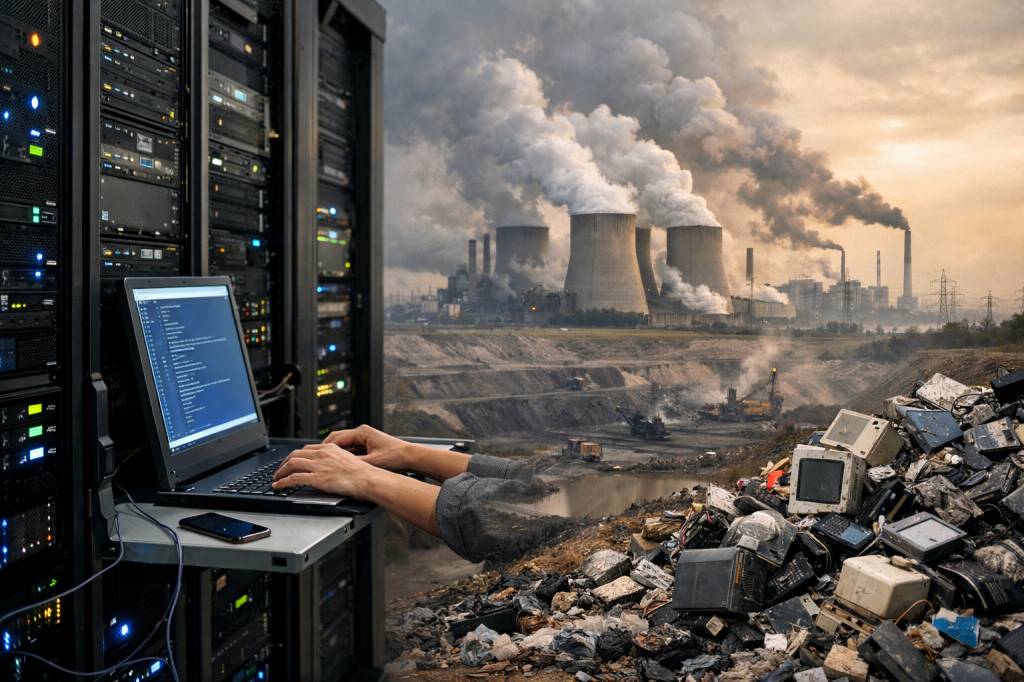
Infinite storage in the cloud, 5G everywhere, streaming in 4K, AI tools on demand… Our digital lifestyle looks immaterial, almost weightless. But behind every tap, swipe, and click, very physical infrastructures are running at full speed – and they’re far from neutral for the planet.
We like to think that “going digital” automatically means “going green”. No paper, no CDs, no DVDs, no car ride to the store… end of story, right? Not quite. The reality is more subtle, and sometimes brutal: the more we dematerialise our lives, the more we lean on data centers, networks, and devices that consume energy, rare materials and water, and generate waste.
Let’s unpack what really happens when we live online 24/7 – and what we can actually do about it without going full digital monk.
The physical side of our “virtual” world
When you open an app, send a meme or launch Netflix, you’re activating a global industrial chain that looks roughly like this:
- Devices (smartphone, laptop, TV, console, smart speakers…)
- Connections (Wi-Fi routers, fiber, 4G/5G antennas, undersea cables)
- Data centers (servers, storage, cooling systems)
Each layer has an environmental cost. Three main axes: energy, resources, and waste.
Energy. According to the IEA, data centers, networks and data transmission account for around 2–3% of global electricity consumption – roughly as much as the entire aviation sector. And demand is still rising with streaming, cloud gaming, and AI.
Resources. Your smartphone contains more than 40 different metals, including rare earths and precious metals. Mining them consumes water, energy, and often takes place in environmentally fragile or politically unstable regions.
Waste. In 2024, the world generated more than 60 million tonnes of e-waste. Only a fraction is properly recycled. The rest ends up in landfills or informal recycling sites, with toxic consequences.
So yes, digital is invisible on your desk. Not so invisible on the planetary scale.
Streaming: the new coal?
Let’s start with the digital habit most of us practice daily: streaming video. YouTube, Netflix, TikTok, Twitch, Reels, Stories… If the internet were a city, video would be the 24/7 traffic jam.
Today, online video accounts for over 60% of global internet traffic. And that traffic isn’t free: each hour of streaming mobilises servers, networks and your device screen – all powered by electricity.
Is streaming “the new coal”? The formula is a bit sensational, but it points to a real issue: watched individually, a video seems harmless; multiplied by billions of views, the energy bill becomes significant.
What really matters:
- Video quality: 4K consumes several times more data than HD, which itself consumes more than SD.
- Screen size: streaming 4K on a 6-inch smartphone screen is overkill most of the time.
- Network type: streaming via fiber or Wi-Fi is generally more efficient per GB than via mobile network.
Do you need to stop streaming? No. But do you need 4K for a 30-second meme in the subway? Also no.
Cloud, email and “infinite” storage
“It’s in the cloud” sounds almost poetic. In practice, it means “stored on someone else’s computer in a data center you’ll never see”. And that computer runs 24/7.
Some orders of magnitude to give context:
- Hundreds of billions of emails are sent every day worldwide.
- Most email accounts contain thousands of unread messages and attachments that nobody will ever open again.
- Every file backed up “just in case” stays on a server – often duplicated multiple times for redundancy.
Does one extra email kill the planet? No. The problem is the scale and the default of “keep everything forever because storage is cheap”. Environmentally, storage is never entirely cheap.
Good news: unlike the hardware itself, our usage here is relatively easy to optimise. More on that later.
AI, crypto and other energy-hungry trends
In the last five years, two major digital trends have sparked intense debate about their energy use: cryptocurrencies and artificial intelligence.
Cryptocurrencies. Some protocols like Bitcoin use “proof of work”, a validation mechanism that requires massive computing power. At its peak, Bitcoin’s annual electricity consumption was comparable to that of a mid-sized country. Other protocols (proof of stake) are much more efficient, but the damage in public perception is done.
AI. Training large AI models requires concentrated, one-off bursts of energy, while running them (inference) spreads consumption across millions of users. The AI sector is rapidly growing its energy demand, and large cloud providers are racing to secure green energy contracts. The reality is nuanced: AI can both increase demand and enable efficiency gains (e.g. better grid management, building optimisation, logistics, eco-design).
As an end user, you have limited control over how models are trained. But you do make choices about which tools you use, how often, and for what purpose. Running heavy AI to summarise a tweet or to generate the 19th version of almost the same logo: probably not the wisest use of resources.
The real environmental hotspot: our devices
Paradoxically, the hidden environmental cost no one wants to face is the one… in your pocket.
For a smartphone, 50–80% of its total environmental impact is generated during manufacturing, not during its use. Same story for laptops and tablets. The extraction of materials, component fabrication, assembly, and transport carry a heavy footprint before you even unbox the device.
Keeping a smartphone 5 years instead of 2–3 is often more impactful than obsessing over every email you send.
Three uncomfortable facts:
- Most smartphone upgrades are driven by marketing and social pressure, not real need.
- Many “obsolete” devices are just victims of software or battery neglect.
- A large share of unused phones sleeps in drawers instead of entering proper recycling channels.
If you care about the footprint of your digital life, your most powerful decision is simple and a bit boring: buy less, and keep devices longer.
So… is digital worse than analog?
The honest answer: it depends what you’re comparing, and how you use it.
Some examples where digital usually wins:
- Remote meetings vs. monthly flights for 2-hour in-person updates.
- Digital documents vs. printing multiple versions for every review cycle.
- Music streaming vs. mass production and shipping of CDs (if you listen to lots of varied music).
And some cases where digital isn’t automatically better:
- Endless online meetings that could be emails, especially with video always on.
- Cloud storage of massive files nobody uses, replicated across regions.
- Hyper-frequent device renewal “just to have the latest”.
The key is not to demonise technology, but to look at its utility vs. cost. Does this digital use avoid a more polluting alternative, or is it just adding an extra layer of consumption?
10 practical ways to shrink your digital footprint (without quitting the internet)
You don’t need to move into a cabin with no Wi-Fi. Small, consistent changes scale surprisingly well – especially in organisations. Here are a few levers that have real impact.
Extend the life of your devices
- Resist useless upgrades: ask yourself if your current smartphone or laptop is really blocking you. If it still works for your actual needs, keep it.
- Repair instead of replace: change a battery, upgrade RAM or storage, fix a screen. Many cities have repair cafés or affordable repair shops.
- Choose repairable brands: look for good repair scores, modular design, and long-term software support.
- Refurbished over new: a quality refurbished device significantly reduces the impact compared to buying new.
Tame your streaming habits
- Lower resolution when it’s enough: SD or HD is often fine on small screens.
- Prefer Wi-Fi over mobile data when possible.
- Download instead of streaming on repeat: for your favourites, offline mode is usually more efficient than streaming the same track 100 times.
- Disable auto-play: your attention and the servers will thank you.
Clean up your cloud and inbox
- Unsubscribe ruthlessly from newsletters you never read.
- Archive or delete old heavy attachments you don’t need.
- Use shared links instead of attachments for large files within teams.
- Set retention policies on collaborative tools (chat, project management) when possible.
Bonus: a lighter inbox also means a lighter mental load.
Optimise your work tools and workflows
If you’re a developer, designer or run a digital business, you have additional levers.
- Eco-design your websites and apps: lighter pages, optimised images, fewer unnecessary scripts – this improves both footprint and performance.
- Simplify user journeys: less friction for the user, fewer useless server calls in the background.
- Challenge “always-on” features: constant polling, real-time updates by default… Ask: does everything really need to be real-time?
- Measure: use analytics and energy estimation tools to identify hotspots instead of guessing.
Choose your providers consciously
Not all cloud, hosting, or streaming providers are equal.
- Look for transparency: energy mix, efficiency, cooling systems, water usage.
- Favour providers investing in renewables and energy-efficient infrastructure.
- Check their commitments: carbon neutrality claims backed by real actions, not just offsets.
You might not move AWS or Google on your own, but aggregated customer pressure does influence roadmaps.
A more mature digital culture
Ultimately, the hidden environmental cost of our digital lifestyle isn’t a moral failing. It’s a blind spot. For 20 years, we’ve been sold an ultra-convenient, frictionless digital world, with a simple narrative: more is always better.
We’re now entering a second phase: asking harder questions.
- Do I really need this new device, this feature, this app?
- Is this digital service solving a real problem, or just creating a new habit?
- Can we design tools that are both powerful and frugal?
Digital technology isn’t going away. AI, IoT, extended reality, cloud gaming – all of this will keep growing. The question is: will we integrate environmental constraints by design, or only after the fact when regulations force our hand?
As individuals, we control our usage and, collectively, we influence the market. As professionals in tech, we control what we build, how we host it, and how we nudge users.
Our “online life” will never be impact-free. But it can be a lot less wasteful, a lot more intentional, and still deeply innovative. The challenge for the coming years is clear: keep the best of the digital revolution, without pretending it floats above physics.
Because behind every cloud, there are servers. And what we do with them is very much our business.
— Lili Moreau