


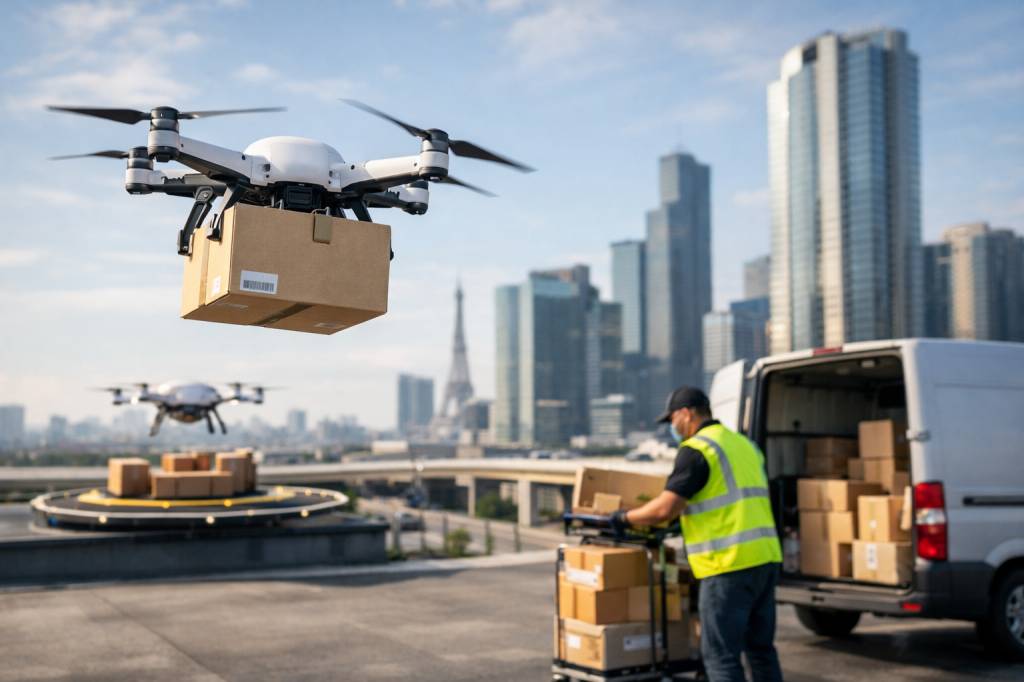
Delivery drones were supposed to stay in sci-fi movies. Yet here we are: groceries dropped in backyards, medicines flying over traffic jams, and e-commerce players betting that the sky is the new sidewalk. Drone delivery is moving from flashy pilot projects to a real piece of urban logistics. The question isn’t “Will it happen?” anymore, but “Where, how fast, and for what use cases does it actually make sense?”
From hype to deployment: what changed?
We’ve been hearing about drone delivery for a decade. So why is it suddenly becoming credible?
A few key shifts explain the new momentum:
- Regulation is (slowly) catching up: aviation authorities like the FAA (US) and EASA (EU) now have clearer frameworks for “beyond visual line of sight” (BVLOS) flights, a prerequisite for scalable operations.
- Hardware got cheaper and smarter: batteries last longer, sensors are more precise, onboard computing is more capable. A drone that cost $30,000 ten years ago can be matched by a sub-$10,000 machine today.
- Urban logistics is under pressure: same-day delivery, congested streets, low-emission zones, labor shortages… The classic van + courier model is hitting its limits in dense cities.
- Proof-of-concept fatigue is real: cities and companies now demand measurable value—cost savings, faster delivery, reduced emissions—not just a PR stunt with a single pizza flying over a park.
In short: the tech has matured, the regulatory path is clearer, and the pain points of urban logistics are intense enough to justify serious experiments.
How drone delivery actually works (beyond the promo videos)
Forget the glossy marketing clips for a minute. A real drone delivery system looks more like an interconnected stack of technologies than a lone gadget buzzing through the sky.
At a high level, you have:
- The drone fleet: multicopters (vertical take-off and landing) or small fixed-wing hybrids. Typical payload today: 1–5 kg, with a radius of 5–15 km depending on battery, wind, and payload weight.
- Ground infrastructure: depots, micro-hubs on rooftops, charging stations, automated loading systems, secured landing or drop-off points.
- Navigation & safety stack: GPS, inertial sensors, obstacle detection (lidar, cameras, radar), geofencing, redundant communication links, emergency landing protocols.
- Air traffic integration: a digital layer to coordinate low-altitude flights, avoid collisions, and comply with no-fly zones. Think of it as “air traffic control for city drones.”
- Logistics & IT integration: orders come from e-commerce, pharmacies, restaurants; drones are assigned missions, routes are optimized, ETAs are updated; customers get tracking links just like any parcel.
The magic is not the drone itself. It’s the orchestration between these layers. Without integration into the broader supply chain, a drone is just an expensive toy with propellers.
Where drone delivery already operates
Drone delivery is not just theory anymore. Several real-world examples help to separate the possible from the exaggerated.
- Medical deliveries in Africa and Asia: Zipline, one of the pioneers, has flown millions of kilometers to deliver blood, vaccines, and medicines in Rwanda, Ghana and beyond. Their drones can fly up to ~120 km round trip and drop packages with a parachute near clinics.
- Suburban food & retail in the US and Europe: Wing (Alphabet), Walmart, and others have ongoing pilots in low-density urban and suburban areas. Customers order via app, receive a 10–15 minute ETA, and the drone lowers the parcel on a tether into their garden or a designated spot.
- Last-mile tests in smart cities: some European and Asian cities are experimenting with rooftop-to-rooftop deliveries between logistics hubs, bypassing street-level traffic.
Notice something? Most successful deployments avoid hyper-dense historic centers. They target suburbs, peri-urban zones, or specific high-value missions like medical supplies.
Where drones make sense in urban logistics
Drone delivery won’t replace every van or bike courier. But it excels in specific use cases where speed, accessibility, or cost justify the complexity.
Promising segments include:
- Urgent medical logistics: blood units, lab samples, critical drugs, organ transport support. Here, cutting 30–60 minutes of delivery time can literally save lives.
- Hard-to-reach areas: islands, areas cut off by floods or storms, hillside neighborhoods with narrow streets, or regions with poor road infrastructure.
- High-value, low-weight items: electronics, documents, spare parts for industrial equipment, medications. The economic equation works better when the margin is high and the parcel is light.
- Off-peak or nighttime logistics: when city centers restrict vans or when labor costs for late-night delivery are high, drones can fill the gap—if local noise and safety regulations allow it.
The golden rule: drones are attractive where the cost per delivery is competitive and where their unique strengths (speed, altitude, access) unlock value that ground transport struggles to provide.
Regulation, safety and the “flying over your head” problem
The main obstacle for drone delivery is not technical. It’s regulatory and social. Flying autonomous machines over people and buildings is a sensitive topic, and for good reason.
Authorities focus on three core issues:
- Air risk: avoiding collisions with other drones, helicopters, and aircraft. This is where low-altitude traffic management (UTM or U-Space in Europe) becomes critical.
- Ground risk: what happens if a drone fails? Can it glide, parachute, or perform a controlled emergency landing away from crowds?
- Data & privacy: onboard cameras and sensors must not turn cities into permanent aerial surveillance zones.
Consequences are visible in how permits are issued. Many pilots are restricted to:
- Specific corridors or “air lanes”, often over rivers, rail tracks, or industrial areas.
- Low-population-density zones or clearly identified rooftops/landing pads.
- Strict operating conditions (weather, visibility, weight, speed).
Public acceptance is the second big variable. Noise, visual pollution, fear of accidents, and privacy worries can quickly derail a project. The cities that move fastest are those where operators engage early with residents, explain what flies where and why, and show tangible benefits (faster medical care, reduced vans in narrow streets, fewer emissions).
The business model question: who really saves money?
Drone delivery is not cheap to set up. Between aircraft, maintenance, insurance, pilots or remote operators, control centers, charging infrastructure, and compliance costs, the upfront investment is substantial.
To be viable, operators need:
- Density of demand: many flights per drone per day, ideally with back-and-forth flows rather than one-way missions.
- Short turnaround times: fast reloading and recharging or battery swapping to keep drones in the air, not on the ground.
- Integration into existing supply chains: drones shouldn’t replace every step, but take over the segments where they clearly outperform vans or bikes.
On the cost side, drones are particularly interesting when they:
- Bypass tolls, congestion charges, or low-emission penalties.
- Reduce failed delivery attempts (no one home, blocked building, etc.), thanks to precise drop points.
- Allow consolidation: one main hub shipping by air to multiple micro-points instead of multiple vans making parallel tours.
Expect mixed models for a while. In many cities, a single parcel might travel by truck to a regional hub, then by electric van to a neighborhood micro-hub, and only the last kilometer handled by drone.
Drones as a new layer of the urban logistics stack
Rather than imagining a sky darkened by thousands of drones, it’s more realistic to see them as an additional layer in the existing logistics stack.
That stack could look like this:
- Long-distance: trains, ships, trucks move containers and pallets between regions.
- Mid-mile: smaller trucks and vans move parcels between city hubs and local depots.
- Last mile (ground): cargo bikes, scooters, and small vans deliver standard parcels to homes and shops.
- Last mile (air): drones handle urgent, time-critical, or hard-to-reach deliveries, or shuttle stock between micro-hubs.
In this perspective, drones don’t compete head-on with every other mode of transport. They specialize. Cities that embrace this layered approach can better balance traffic, emissions, noise, and public space usage.
Environment: clean solution or greenwashing risk?
Electric drones emit no exhaust locally, which makes them attractive in low-emission zones. But how green are they really?
Points in their favor:
- Lower energy per parcel than a half-empty diesel van stuck in traffic, especially for light loads.
- Potential to reduce congestion by replacing some short van trips in dense areas.
- Integration with renewable energy when charging infrastructure is tied to solar or wind.
Open questions remain:
- Battery production and end-of-life impact.
- Fleet size: replacing 10 vans with 500 small drones may not be neutral in terms of noise and manufacturing footprint.
- The rebound effect: if instant delivery becomes too easy, will we multiply low-value deliveries?
The environmental scorecard will depend heavily on how cities and operators deploy drones: targeted, complementary use vs. “always-on convenience” for anything and everything.
What this means for businesses today
Even if your company won’t launch its own drone fleet tomorrow, the shift is worth monitoring—and preparing for.
For retailers, e-commerce players, and logistics providers, a few pragmatic steps make sense:
- Map your high-value, time-critical flows: which products or routes would benefit most from shaving off 30–60 minutes of delivery time?
- Audit your infrastructure: do any of your sites (rooftops, parking, depots) lend themselves to drone pads or micro-hubs?
- Integrate flexibility in IT systems: make sure your order management and tracking solutions can eventually hand off a parcel to different carriers, including aerial ones.
- Track local regulation: city-specific rules will matter more than national hype. Some municipalities will move much faster than others.
- Test with partners: instead of building drones in-house, most companies will partner with specialized operators and run limited pilots on a clear use case.
The competitive advantage won’t necessarily come from the drone itself, but from how smoothly it plugs into your broader logistics ecosystem.
How cities can keep control of the sky
Cities have learned the hard way with scooters and ride-hailing: if you let a new transport mode grow without a plan, you end up managing chaos. Drone delivery offers a second chance to do things differently.
Key levers for urban planners and regulators include:
- Designating drone corridors and altitudes to protect sensitive areas and reduce noise where it’s most disturbing.
- Setting data and privacy rules to limit unnecessary image collection and secondary use of sensor data.
- Requiring impact assessments on safety, noise, and emissions before scaling operations.
- Encouraging shared infrastructure: common landing pads or hubs instead of each operator building a parallel network.
- Opening public tenders for critical missions (medical, disaster response) rather than letting only commercial players shape the ecosystem.
If the sky becomes a new layer of urban logistics, it should be governed with the same seriousness as roads—not as a free-for-all playground.
What to watch in the next 3–5 years
The adoption curve of drone delivery will be uneven, but a few signals will tell us whether we are crossing from niche to mainstream.
- BVLOS regulation at scale: widespread authorization for routine beyond-visual-line-of-sight flights over populated areas would be a major turning point.
- Standardized UTM systems: once multiple operators can plug into a common low-altitude traffic layer, scaling becomes much more realistic.
- Economics vs. electric vans and bikes: if drones can beat or match the cost per delivery for certain segments, adoption will accelerate quickly.
- New form factors: quieter rotors, better batteries, hybrid aircraft that combine vertical take-off with efficient forward flight could extend range and capacity.
- Public perception: a major accident in a dense city could push regulation back years; conversely, visible benefits (e.g. faster medical care) can build trust.
Drone delivery is not the end of urban logistics as we know it. It’s another layer—one that flies, one that forces us to rethink the vertical dimension of our cities, and one that will test our ability to balance innovation with safety, privacy, and everyday usefulness.
For now, the most interesting question is not “Will my next burger be delivered by drone?” but “Which parts of the logistics chain should really take off—and which are better left on the ground?”