








Smart kitchens: when your oven becomes smarter than you
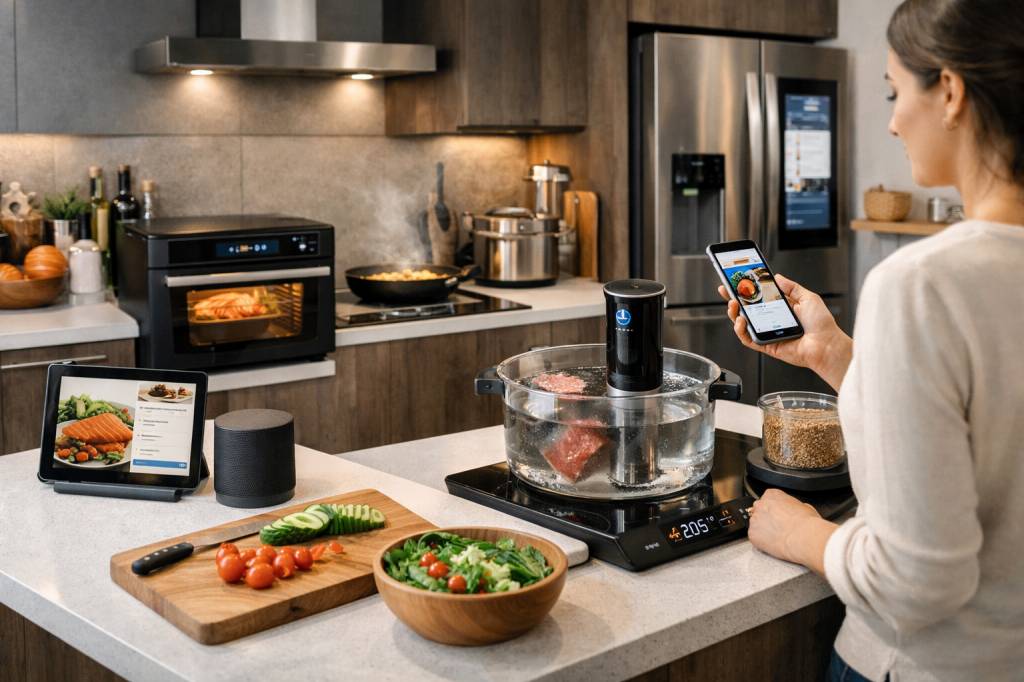
Fridges that tell you when the milk is expired, ovens that recognize your dish, voice assistants that manage your shopping list… No, this isn’t a sci-fi movie, it’s your future kitchen. The “smart kitchen” is no longer a niche concept for gadget lovers; it’s a fast-growing segment of the connected home, driven by real use cases: saving time, reducing waste, eating better, and optimizing energy.
But how much of this is truly useful, and what’s just marketing glitter? Let’s unpack what’s behind the rise of smart kitchens and connected cooking – and how it might actually change the way you cook, shop, and eat.
What exactly is a “smart kitchen”?
A smart kitchen combines connected appliances, sensors, and software (apps, voice assistants, AI) to help you:
- Plan and prepare meals more easily
- Track food stocks and expiration dates
- Automate or simplify cooking steps
- Limit food waste
- Monitor and optimize energy use
In practical terms, this can mean:
- A fridge that sends you a photo of its contents when you’re at the supermarket.
- An oven you preheat from the office via an app.
- A connected scale that adjusts ingredient quantities automatically.
- A voice assistant that walks you through a recipe hands-free.
Individually, none of these features are revolutionary. Together, they start to form an ecosystem where the kitchen is no longer an isolated room, but a node in your digital lifestyle.
The tech bricks behind connected cooking
How does this all work in practice? Under the sleek screens and minimalist designs, we mostly find the same technologies that power the rest of the smart home.
1. IoT sensors and connectivity
Smart kitchen devices rely on sensors to detect:
- Temperature and humidity (fridge, oven, wine cellar)
- Weight (connected scales, smart coffee machines)
- Presence and movement (cooktops with automatic shutdown)
- Gas or smoke leaks (safety sensors)
These sensors are connected via Wi-Fi, Bluetooth, Zigbee or proprietary protocols to an app or a central hub. This is what enables remote monitoring and control.
2. Apps and cloud services
Almost every smart kitchen device comes with its own app: sometimes well thought out, often redundant. The real added value appears when the app acts as a control center rather than a simple remote control. For example:
- Saving and sharing cooking programs
- Automatic updates and new features over time
- Synchronizing recipes with your appliances (time, temperature, mode)
Many brands also rely on cloud services to store preferences, usage history, and personalized recommendations. This raises questions about data privacy – we’ll get back to that.
3. AI and computer vision
This is where things start to get interesting. AI is gradually creeping into the kitchen to:
- Recognize ingredients from a photo or camera (inside your fridge or above your worktop)
- Suggest recipes based on what you have left
- Automatically adjust cooking parameters (time, temperature, steam)
- Detect errors (forgotten pan, open door, burning food)
For example, some high-end ovens now identify the type of dish you’ve put inside (fish, vegetables, meat), estimate quantity, and propose an automatic program. It’s not magic; it’s a mix of computer vision models and machine learning trained on thousands of cooking cycles.
4. Voice assistants as sous-chefs
Alexa, Google Assistant and Siri have taken up residence on the kitchen counter.
Their strengths?
- Hands-free control (no need to touch your phone with dough-covered fingers)
- Timers, conversions, and quick searches on the fly
- Integration with other devices (oven, lights, speakers, blinds)
“Hey Google, set the oven to 180 degrees and start a 20-minute timer” is a very typical use case when you’re juggling three pots and a video call in the background.
From recipe books to dynamic, adaptive recipes
The recipe itself is being transformed by connected cooking.
Static recipes are becoming interactive
Rather than reading a recipe that assumes a standardized oven and perfectly calibrated ingredients, smart systems start to adapt steps based on:
- Your equipment (gas stove, induction, steam oven, air fryer)
- Your constraints (30 minutes max, vegetarian, low-salt)
- Your stock (no crème fraîche, but Greek yogurt available)
Some apps can now synchronize directly with your appliances: tapping “Start recipe” sets your oven, launches timers, and sends alerts to your phone or watch at key moments.
Real-time guidance instead of guesswork
Think about baking a roast. Traditionally, you rely on cooking times indicated “per kilo” and a bit of intuition. A connected oven with a core temperature probe can track the cooking process and tell you:
- Estimated time remaining
- When to lower the temperature
- When to let the meat rest
Result: you get repeatable, predictable outcomes instead of “this worked once, but I have no idea why.”
Smart fridges and the war on food waste
One of the most promising applications of smart kitchens sits quietly against your wall: the fridge.
Inventory tracking and expiration alerts
In theory, a smart fridge can:
- Track what goes in and out (via cameras, barcodes, or manual input)
- Monitor expiration dates
- Suggest recipes based on what’s about to expire
- Generate shopping lists automatically
In practice, we’re not fully there yet. Camera recognition is still imperfect, barcodes don’t cover loose produce, and manual data entry is… tedious. But progress is real, especially when fridge data is synced with your grocery app.
From passive storage to active assistant
A fridge that simply keeps things cold is passive. A smart fridge can become an active player in your food habits:
- Sending you a notification: “You’re low on milk and eggs, reorder?”
- Highlighting forgotten items at the back of the shelf
- Suggesting: “You have tomatoes, feta and pasta – here are three 20-minute recipes”
When you know that an average European household wastes around 30 kg of food per year, there’s a real economic and ecological stake here, beyond the gimmick.
Energy, safety and maintenance: the quiet advantages
Smart kitchens aren’t only about fancy recipes and Instagram-ready meals. Some of the least visible features are the most impactful.
Optimized energy use
Connected appliances can:
- Suggest off-peak operating times based on energy tariffs
- Automatically switch to eco modes when possible
- Provide detailed consumption statistics per cycle or per dish
For example, a connected dishwasher can delay its start to the cheapest hours without you having to remember to press a button at 11 pm.
Safety first
Kitchens are risk zones: fire, gas, burns. Smart systems add safety nets such as:
- Automatic shutdown after idle time
- Remote alerts if a burner is left on
- Gas and smoke leak detection
- Child locks controlled from your phone
For elderly or vulnerable people, these features can make the difference between an accident and a minor scare.
Predictive maintenance instead of sudden breakdowns
Modern appliances are more complex, and when they fail, they tend to fail badly. Smart diagnostics allow:
- Monitoring parts wear (filter, pump, heating elements)
- Early detection of anomalies (abnormal vibration, overheating)
- Remote support by the manufacturer
This doesn’t remove the cost of repairs, but it improves predictability and lifespan. In some cases, a simple software update can fix bugs that would previously have required a technician visit.
What’s hype and what’s actually useful?
Let’s be honest: not every smart kitchen feature is worth your money.
Nice-to-have (borderline gimmick)
- A fridge screen that lets you post digital notes when you already have a family chat group.
- A coffee machine that tweets when your espresso is ready.
- A fork that vibrates when you eat “too fast.”
These products exist. They make headlines, but not habits.
High potential, if well executed
- Adaptive cooking programs that genuinely improve results.
- Smart inventory + recipe suggestions that reduce waste.
- Integrated energy management for the entire kitchen.
- Accessible, inclusive interfaces (for visually impaired, for example, via voice).
The key difference? These features solve real problems that people already have, instead of inventing new “needs” around them.
Data, privacy and lock-in: the other side of the coin
When your fridge knows what you eat and your oven knows when you’re home, the question of data isn’t optional.
What kind of data does your kitchen collect?
Potentially:
- Your consumption habits (type of food, frequency of cooking, hours of use)
- Your shopping preferences (brands, quantities, budget)
- Behavioral data (how often you use eco modes, preheat, etc.)
Aggregated, this data is extremely valuable for brands and retailers. It can inform product design, marketing strategies, and personalized offers.
The risk of closed ecosystems
Another issue: lock-in. Many brands push you toward their proprietary ecosystem:
- Brand-specific apps that don’t talk to competitors’ devices
- Exclusive recipe platforms compatible only with “their” appliances
- Connected features requiring paid subscriptions after a trial period
The result is a kitchen that’s smart… as long as you stay loyal to a single manufacturer. Mix brands, and you often lose connectivity or features.
Pragmatic approach
Before buying, ask:
- Does this device support standard protocols (Matter, Zigbee, HomeKit, etc.)?
- What happens if the brand shuts down its cloud service?
- Can the appliance still function “offline” for basic tasks?
Your kitchen should remain usable even if your Wi-Fi drops or the company behind the fancy app disappears.
How to make your kitchen smarter without starting from scratch
You don’t need to replace everything with connected versions to benefit from smart cooking. The most effective setups are often hybrid.
Start with low-cost, high-impact devices
- Smart plugs to schedule and monitor non-connected appliances (kettle, coffee maker).
- Smart thermostats and thermostatic valves if your kitchen is an energy hotspot.
- Connected scales if you cook or bake frequently.
- A smart speaker as a central control and voice assistant.
Digitize your recipes and shopping
- Use apps to centralize your recipes, label them (time, difficulty, diet) and sync them across devices.
- Adopt a shared digital shopping list (family or shared flat) synced with reminders.
- Test at least one app that suggests recipes from your leftover ingredients.
The return on investment in time and energy is often immediate, even without a connected oven that costs as much as a used car.
Upgrade strategically
When an appliance dies and needs replacement, ask:
- Is the smart version significantly more expensive than the “dumb” one?
- Which connected features will I actually use weekly, not just the first weekend?
- Is this product compatible with my existing smart home setup?
A connected oven with accurate temperature, reliable programs, and remote alerts can genuinely change your daily life. A smart toaster that toasts “according to the weather”? Probably not.
Will the kitchen of the future cook without us?
The fantasy is tempting: you drop ingredients in a device, press a button, and dinner appears perfectly cooked, on time. Some devices are getting close for specific use cases (multi-cookers, bread machines, smart rice cookers).
But for now, full automation runs into several limits:
- Ingredient variability (size, water content, ripeness)
- Personal taste (texture, browning, seasoning)
- Space constraints (not everyone wants five different robots on their counter)
What’s more realistic in the short term is a co-pilot model: machines handle precision, repetition, and timing; humans keep control over choices, tasting, and improvisation. Think autopilot on a plane: it assists, but doesn’t replace the pilot.
A smarter kitchen is one that respects your reality
A truly smart kitchen isn’t necessarily the most connected, or the one with the most screens. It’s the one that best matches your constraints:
- Limited time to cook during the week
- Budget to keep under control
- Dietary choices (vegetarian, low-carb, allergies)
- Small urban kitchen vs. family house
If a single well-chosen connected appliance helps you cook at home more often instead of ordering delivery, that’s already a significant win in terms of health, budget, and environmental impact.
The question to ask yourself before each new purchase is simple: “Will this make my life easier every week, or is it just a toy I’ll show off twice?” The rise of smart kitchens and connected cooking is offering powerful tools. It’s up to us to use them with discernment – and maybe, once in a while, to unplug everything and enjoy the simple pleasure of cooking by feel.