


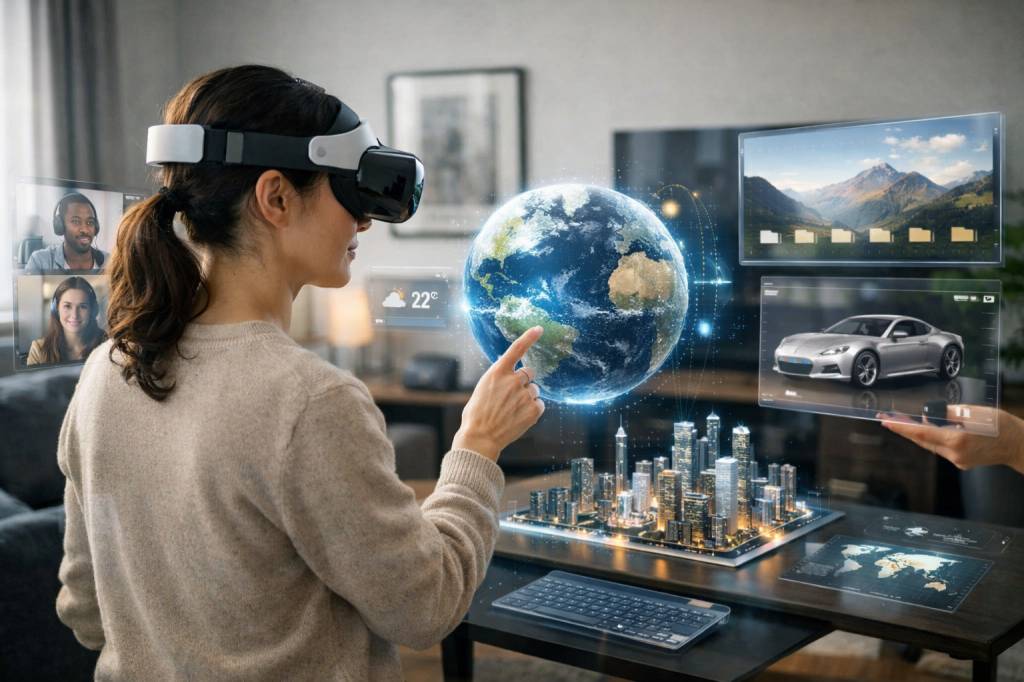
For years, our devices have lived behind screens: phones in our hands, laptops on our desks, TVs on our walls. Spatial computing wants to blow up that frame. Instead of looking at apps in 2D rectangles, we interact with digital content that lives in our physical space – on our tables, walls, and even in mid-air.
If that sounds like sci-fi marketing, it’s because a lot of it has been, for a long time. But the hardware, software, and use cases are finally starting to line up. Between Apple’s Vision Pro, Meta’s Quest line, Microsoft’s HoloLens, and a wave of new sensors and platforms, spatial computing is quietly redefining what “everyday tech” could look like in the next five years.
The real question isn’t “Is spatial computing cool?” It’s: Will it actually be useful in daily life? Let’s unpack that.
What is spatial computing, exactly?
Forget the buzzwords for a moment. Spatial computing is about one simple idea: your devices don’t just show you content; they understand and augment the space around you.
More concretely, a spatial computing system typically:
- Maps your environment in 3D using cameras and depth sensors (walls, furniture, objects).
- Tracks your body and hands so it knows where you are looking, pointing, and moving.
- Anchors digital objects to real-world positions so they stay put when you move.
- Lets you interact naturally using gestures, gaze, voice, or real-world objects – not just clicks and taps.
It’s the difference between watching a cooking video on your phone and having a recipe float next to your stove, reacting to your movements and the tools you pick up.
Under the hood, spatial computing is a mix of:
- AR (augmented reality)
- VR (virtual reality)
- MR (mixed reality)
- Computer vision
- 3D mapping and tracking
- AI for object, scene, and gesture recognition
All of that gets wrapped into experiences that feel less like “apps on a screen” and more like “digital layers stitched into your real life”.
Why spatial computing is taking off now
Spatial computing isn’t new. The first HoloLens came out in 2016. Google Glass dates back to 2013. The Nintendo Wii was tracking motion in living rooms in 2006. So why does it suddenly feel like the hype is waking up again?
Three main reasons.
1. Hardware finally looks (almost) normal
Early headsets were heavy, clunky, and screamed “prototype”. Today:
- Meta Quest 3 is lighter, cheaper, and offers decent passthrough AR.
- Apple Vision Pro set a new standard for clarity, tracking, and integration with existing apps, even if the price is eye-watering.
- Chipsets from Qualcomm and Apple are built specifically for spatial workloads.
We’re not yet at “AR glasses that look like regular glasses”, but we’ve moved from “lab equipment” to “consumer gadget you can actually use for more than 20 minutes”. That’s a big step.
2. AI fills in the missing intelligence
Spatial computing only becomes interesting when the system understands what it sees. That used to be a huge technical bottleneck. With modern AI and on-device machine learning, devices are getting much better at:
- Recognizing objects (chair, table, keyboard, whiteboard).
- Identifying surfaces (floor, ceiling, desk).
- Tracking hands and eyes with low latency.
- Understanding voice commands in noisy environments.
Instead of you adapting to the device – pointing controllers at weird menus – the device starts adapting to you and your environment.
3. The use cases are maturing
Early AR demos were mostly floating 3D dinosaurs and gimmicky filters. Fun, but not exactly life-changing. Now we see more grounded applications:
- Remote assistance for technicians where experts “draw” in your field of view.
- Collaborative design where 3D models sit in the middle of a meeting room.
- Spatial video, where your recordings capture depth and can be replayed in 3D.
- Fitness, training, and simulation blending real movement with virtual feedback.
It’s still early, but the shift is clear: from “look what we can render” to “look what we can actually do”.
How spatial computing will infiltrate everyday tech
Most people won’t wake up one day and say, “I’m entering the spatial computing era.” New tech usually sneaks in quietly, behind familiar tasks. Here’s where the change will be most visible in the near term.
Working with screens that don’t exist
One of the first mainstream uses of spatial computing is brutally simple: replace physical monitors with virtual ones.
Instead of two 27-inch screens on your desk, you put on a headset and get a wall of resizable displays floating in front of you. You can:
- Pin your code on the left, documentation in the center, logs on the right.
- Open a huge spreadsheet without constant scrolling.
- Take your entire multi-screen workspace on a plane or into a tiny apartment.
Apple is pushing this with Vision Pro’s “infinite canvas” and Mac integration. Meta is doing something similar with virtual desktops on Quest. For knowledge workers, this isn’t sci-fi; it’s a potential ergonomic and productivity upgrade – assuming the headsets become light and affordable enough for daily use.
Will everyone want to wear a device for eight hours a day? Probably not. But for developers, traders, designers, or anyone who lives in front of screens, “monitorless computing” could be the first practical taste of spatial tech.
Redefining how we learn and train
Spatial computing shines whenever you need to understand space, movement, or complex systems. That makes education and training a natural fit.
Imagine:
- Learning anatomy by walking around a 3D heart pumping in your living room, peeling away layers with your hands.
- Practicing complex repairs on a virtual engine where each part can be exploded, examined, and reassembled.
- Taking safety training in a simulated factory where machines, alerts, and hazards react to your actions.
Companies are already using VR and AR for training pilots, surgeons, and field technicians. As hardware becomes cheaper, the same tools can trickle down to universities, vocational schools, and eventually home learning.
The impact on retention and engagement is measurable: multiple studies show that interactive 3D simulations can improve learning outcomes compared to passive videos or text, especially for spatially complex topics.
Shopping becomes “try before you buy” for real
E‑commerce has already gone from text-only to photos to videos to 3D models. Spatial computing is the next logical step: place the product in your world before buying it.
We’re starting to see:
- Furniture and decor apps that let you drop a sofa or lamp into your living room at true scale.
- Virtual fitting rooms to check how glasses, watches, or makeup look on your face.
- AR overlays in physical shops that add extra info, reviews, or variants as you look at shelves.
Right now, most of that runs through a smartphone camera held at arm’s length. It works, but it’s clumsy. With spatial devices, it becomes hands-free and persistent: that new couch stays in place while you walk around it, sit “on” it, and test different colors.
For retailers, the incentive is simple: reduce returns, increase confidence, and make online shopping feel less like guessing and more like testing.
Gaming and entertainment go beyond the TV
Gaming is usually where new interactive tech proves itself first – and spatial computing is no exception.
We’ve already had a taste:
- Pokémon GO put digital creatures into city streets.
- Beat Saber turned your living room into a neon rhythm arena.
- Mixed reality modes let enemies break through your actual walls or hide behind real furniture.
As tracking improves, your living space becomes part of the game mechanics. That makes experiences more physical, social, and context-aware. Think of party games where your ceiling, stairs, or sofa are part of the level design.
On the entertainment side, spatial video and 3D capture open a different door: revisiting memories as if you’re standing back inside them. Apple and others are pushing “spatial videos” you can watch in a headset, with depth and presence. Is that a niche? For now, yes. But capturing personal moments in 3D may become as normal as taking panoramic photos.
Smarter homes with interfaces you don’t touch
Smart home devices already fill our rooms with sensors: cameras, microphones, motion detectors, thermostats. Spatial computing connects them into one coherent model of your space.
Imagine walking into your kitchen and saying, “Movie mode,” and instead of a single light scene change, your home reacts spatially:
- Lights dim selectively in the areas the system knows are in your field of view.
- Notifications stop appearing on devices in that room, but not in others.
- Your TV expands into a wall-sized virtual screen, while virtual blinds “darken” the remaining space.
Interfaces shift from “screens everywhere” to contextual overlays that appear only when and where you need them: a volume slider near the speaker, a recipe above the cutting board, navigation arrows on your floor.
For once, the “smart home” might actually feel smart, not just connected.
What changes for developers and creators
If you build digital products, spatial computing isn’t just a new platform; it’s a new language of interaction.
Some concrete shifts:
- From pages to places: You’re not designing a flat layout, but arranging content in 3D around a user who can move.
- From clicks to gestures and gaze: What happens when someone just looks at an object for two seconds? When a hand touches a virtual button that’s anchored to a real table?
- From one viewport to many: Users can walk around your UI. That means thinking about scale, depth, occlusion, and comfort.
On the technical side, ecosystems are emerging:
- Apple’s visionOS for Vision Pro, heavily integrated with existing iOS and macOS tools.
- Meta’s Horizon OS and SDKs built on top of Unity/Unreal and web-based frameworks.
- WebXR, which tries to make spatial experiences accessible from the browser.
Developers with experience in 3D engines, gaming, or real-time graphics have an advantage, but the barrier is going down. Expect more drag-and-drop tools, low-code platforms, and spatial design kits that abstract away some of the complexity.
The key mental update: stop thinking in “screens and scroll” and start thinking in “volumes and presence”.
The hard problems no one can ignore
Now for the less glamorous part. Spatial computing raises a few serious questions that matter before we stick headsets on millions of faces.
Privacy in 3D
A spatial device doesn’t just capture what’s on your screen – it captures your room, your body, your movements, and potentially the people around you.
- Who owns the 3D map of your home?
- Can apps infer sensitive information based on your furniture, books, or objects?
- What happens when bystanders are recorded in spatial video without consent?
Some vendors promise on-device processing and encryption, but the incentives to monetize this kind of data will be strong. Regulators are only beginning to understand what’s at stake when “camera access” now means “full 3D reconstruction of your life”.
Physical and mental fatigue
Extended headset use can cause:
- Eye strain from focusing on displays that simulate depth.
- Neck strain from extra weight.
- Motion sickness when tracking or framerate isn’t perfect.
On the psychological side, blending digital and real environments may blur boundaries for some users. We already know that excessive 2D screen time impacts attention and sleep; spatial tech intensifies immersion. Health guidelines, usage limits, and better ergonomics will be essential if these devices aim for everyday adoption, not just short bursts.
Social friction
Headsets isolate. Even with passthrough AR, there’s still a layer between you and others. Will you wear one at a family dinner? On the train? In the office?
For spatial computing to become truly “everyday”, form factor matters as much as functionality. We’re likely to see:
- Lightweight AR glasses for casual, on-the-go overlays.
- Bulkier, more immersive headsets for focused work or entertainment sessions.
Until devices look and feel closer to regular eyewear, mainstream usage will stay context-specific: at home, in controlled work settings, or for specific tasks.
So what should you actually do with this, today?
Spatial computing is not a binary switch. You don’t have to “move into the metaverse” or ignore the whole topic. There’s a middle path: experiment where it makes sense.
Depending on who you are, that can look very different.
If you’re a curious user
- Test a headset in-store or borrow one to see which use cases feel natural: media, games, remote work?
- Try AR features you already have on your phone (furniture preview, navigation overlays) and notice what actually helps versus what feels like a gimmick.
- Pay attention to comfort: how long can you realistically wear a device before it becomes tiring?
If you’re a developer or product builder
- Explore Unity, Unreal, or WebXR, even for small prototypes. Building one spatial interaction teaches more than reading ten articles.
- Look at your existing product: are there parts that are inherently spatial (maps, plans, training steps, 3D objects)? Those are your entry points.
- Design around a real user scenario, not a tech demo. “What problem becomes easier in 3D than in 2D?” is the filter that matters.
If you’re in business or leadership
- Don’t greenlight “metaverse projects” just to tick a box. Tie experiments to measurable outcomes: faster training, lower error rates, fewer returns, higher engagement.
- Start small: pilot spatial tools in one team or location where the value is obvious (field support, complex assembly, design review).
- Track not just ROI, but acceptance: do people actually prefer the spatial solution to the existing one?
From screens to spaces: a slow but real shift
Spatial computing won’t replace phones and laptops overnight. For a long time, it will coexist with traditional screens, sliding into our lives through very specific doors: better training, more flexible workspaces, richer games, smarter shopping, and more intuitive interfaces for the physical world.
The important shift is conceptual: we’re moving from computing on devices to computing in environments. Our walls, tables, and rooms become canvases. Our hands and eyes become primary controllers. Apps stop being rectangles and start being companions living alongside us.
As always with emerging tech, the gap between promise and reality is wide. Not every spatial gadget will be useful. Not every “immersive experience” will be worth the headset strap mark on your forehead. But underneath the hype, the trajectory is clear: the digital world is stepping out of the screen and into our space.
The real challenge – and opportunity – for everyday tech is simple: make that step feel natural, helpful, and worth repeating.
That’s the moment when spatial computing stops being a buzzword and quietly becomes part of how we live, work, and play.